
Outdoor shading for UK schools: a practical guide

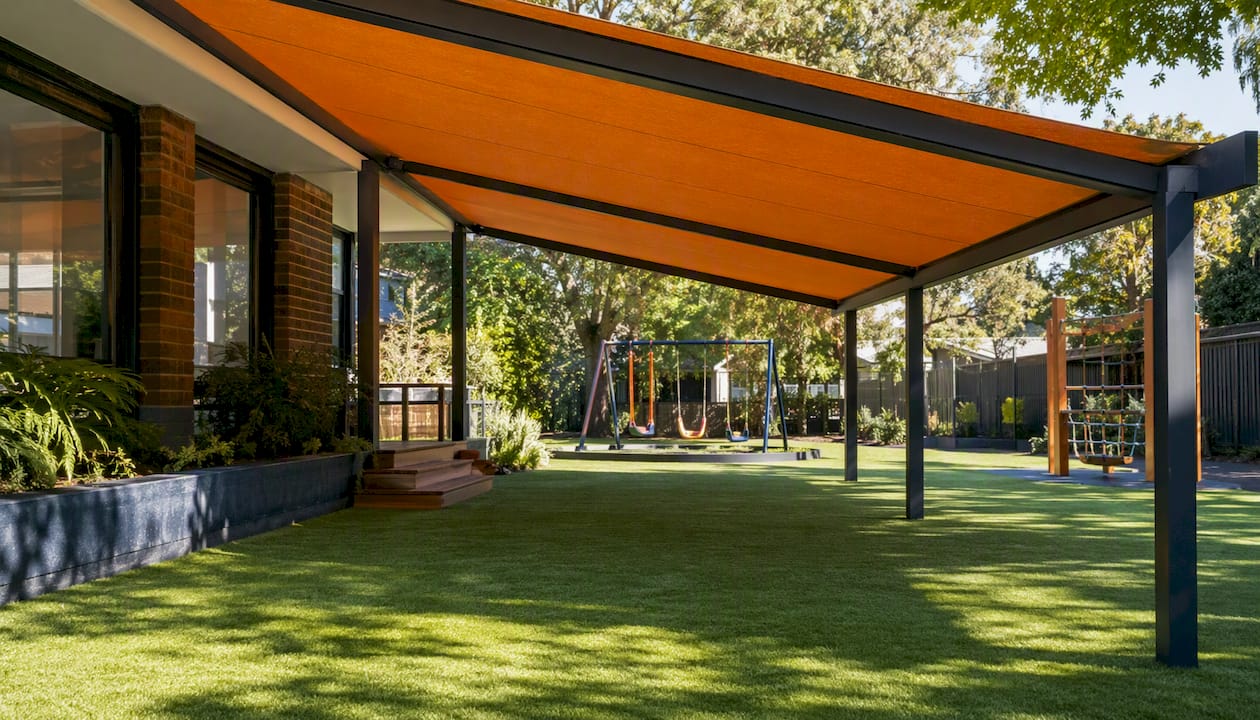
Commercial canopies, tensile shade sails, modular pergolas and retractable awnings are the most practical outdoor shading solutions for UK schools. Commission a site survey first — it is the single step that turns a vague budget line into an accurate specification. The DfE Technical Manual frames external shading as a passive design requirement, not an optional upgrade, and the Natural Connections Demonstration Project across 125 schools and around 40,000 pupils confirms that usable outdoor space directly improves pupil motivation and behaviour. Infinityawnings has delivered school shading projects across Yorkshire, Derbyshire, Nottinghamshire and Lincolnshire for over 15 years.
Fastest wins: a well-specified shading project delivers:
More usable outdoor hours across all seasons, not just summer
Reduced overheating risk in classrooms adjacent to south-facing glazing
Clear supervision sightlines built into the design from day one
A documented compliance trail aligned to DfE passive design guidance
Key takeaways
The most effective school shading projects start with a site survey and a specification that references DfE passive design guidance, UPF 50+ fabrics and clear supervision sightlines.
Point | Details |
Start with a site survey | A survey is the only reliable basis for an accurate specification and budget before tendering. |
Cite DfE and LOtC evidence | Reference the DfE Technical Manual and LOtC SROI evidence in your business case to governors. |
35% of schools lack outdoor learning | WWF’s 2024 survey shows the infrastructure gap; shading directly addresses it. |
Whole-life cost beats headline price | Check fabric and structural warranties, annual inspection costs and maintenance contract terms. |
Infinityawnings covers the full scope | Survey, specification, planning support, installation and maintenance across Yorkshire and surrounding counties. |
Table of Contents
Why does outdoor shading matter for learning and wellbeing?
Shading is infrastructure, not amenity. A covered outdoor space extends the teaching day outdoors in wet and sunny weather alike, and the evidence for what that delivers is substantial.
The Natural Connections Demonstration Project found improved pupil enjoyment, behaviour and staff confidence across its four-year programme. The LOtC evidence summary goes further, citing a positive social return on investment when outdoor learning is embedded as whole-school practice rather than an occasional trip. That SROI argument is worth including in any business case you put to governors.
Statistic to cite in your business case: A 2024 Schools for Nature survey found that 35% of schools provided no outdoor learning opportunities — a gap that inadequate infrastructure, including the absence of all-weather shading, directly contributes to.
The 2026 ESD Forum review of outdoor learning reinforces this, identifying design and access to school grounds as critical enablers and recommending strategic planning of outdoor spaces to address equity. Schools that install awnings for safer outdoor spaces are also reducing overheating risk in adjacent classrooms, which the DfE Technical Manual treats as a climate resilience priority.
Which shading types work best on a school site?
The right solution depends on the specific zone: playground, outdoor classroom, covered dining, or circulation route. Each structure type has a different permanence, planning footprint and maintenance profile.
Fixed canopies and covered walkways
The workhorse of school shading. Steel-framed polycarbonate or tensile-fabric canopies cover large areas at a predictable cost and require minimal day-to-day management. Best for dining areas, main playgrounds and entrance routes. Planning permission is often avoidable under Class M permitted development, though size and boundary proximity can still trigger a formal application.
Tensile shade sails
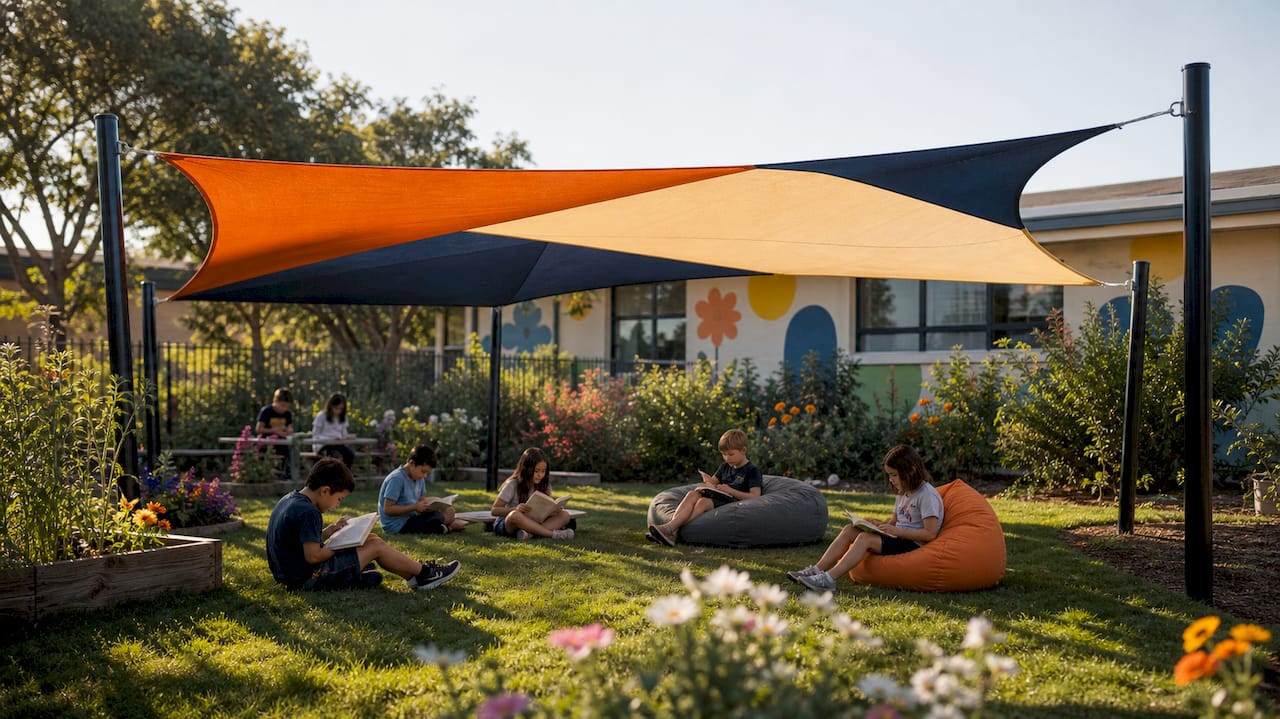
Lower capital cost and visually lighter than a fixed canopy. Shade sails suit smaller zones — reading corners, sandpits, seating areas — where a rigid structure would feel heavy. The trade-off is seasonal: most sail installations require removal or de-tensioning over winter, adding a maintenance task each term.
Pergolas and louvred pergolas
Brands such as Weinor, Tarasola and Morvelle produce louvred pergola systems where the roof blades rotate to control light and ventilation. This suits outdoor classroom settings where teachers want to modulate conditions rather than simply block sun. A louvred pergola also reads architecturally as a permanent building element, which can support planning and estates asset registers.
Retractable awnings
Weinor, Llaza and Selt manufacture commercial-grade retractable awnings suited to south and south-west-facing classroom exits. Motorised operation with wind sensors means the structure retracts automatically in high winds, reducing structural risk. The DfE Technical Manual specifically recommends horizontal external shading to south, south-east and south-west windows to reduce peak solar gains — retractable awnings address this precisely.
Cantilever parasols and brise soleil
Cantilever parasols work well for small outdoor seating areas and are genuinely portable. Brise soleil — fixed louvred screens attached to a building façade — provides permanent solar control without a separate foundation, though it requires structural integration and is typically specified at the design stage of a new build or major refurbishment.
Pro Tip: Ask any supplier whether their systems are modular. A pergola or canopy that accepts extension bays means you can phase the project across budget years rather than committing the full capital cost upfront.
What design and safety checks must your brief include?
Design must balance solar protection, ventilation and maintenance access — all three are referenced in the DfE Technical Manual. A brief that omits any one of them will generate post-installation problems.
Regulatory and safety checklist for your brief:
Planning permission: Class M permitted development covers many school canopy projects, but listed buildings, conservation areas and structures exceeding size thresholds require a formal application. Allow up to eight weeks for a standard application.
Building regulations: Permanent structures with foundations typically require Building Regs sign-off; your supplier should confirm scope and arrange a structural engineer’s calculations.
Supervision sightlines: Posts and roof edges must not create blind spots. Request a sightline diagram from every tenderer. Read more on safety considerations for school awnings.
Fire-retardant fabric certification: Specify fabrics tested to EN 13501-1 or equivalent. Ask for the actual test certificate, not just a claim. See fire-rated awnings for schools for what to look for.
UPF rating: UPF 50+ is the standard for school shade fabrics. Domestic-grade fabrics are not adequate for term-time commercial use.
Foundations and drainage: Groundworks are often the largest single cost variable. Confirm soil type, drainage requirements and any underground services before finalising a budget.
Accessibility: Ensure clear headroom and unobstructed routes for wheelchair users and pushchairs throughout.
CDM regulations: Projects above certain thresholds require a Principal Designer and Principal Contractor under the Construction (Design and Management) Regulations 2015.
Pro Tip: Require every tenderer to submit engineering drawings, fabric test certificates, wind-load calculations and a draft maintenance plan as part of their bid. Suppliers who cannot provide these documents at tender stage are unlikely to manage the project smoothly.
How do you run procurement for a school shading project?
Prioritise site survey, safeguarding compliance, whole-life cost and supplier credentials when comparing bids. A low headline price that omits groundworks or carries a short warranty is rarely the best value.
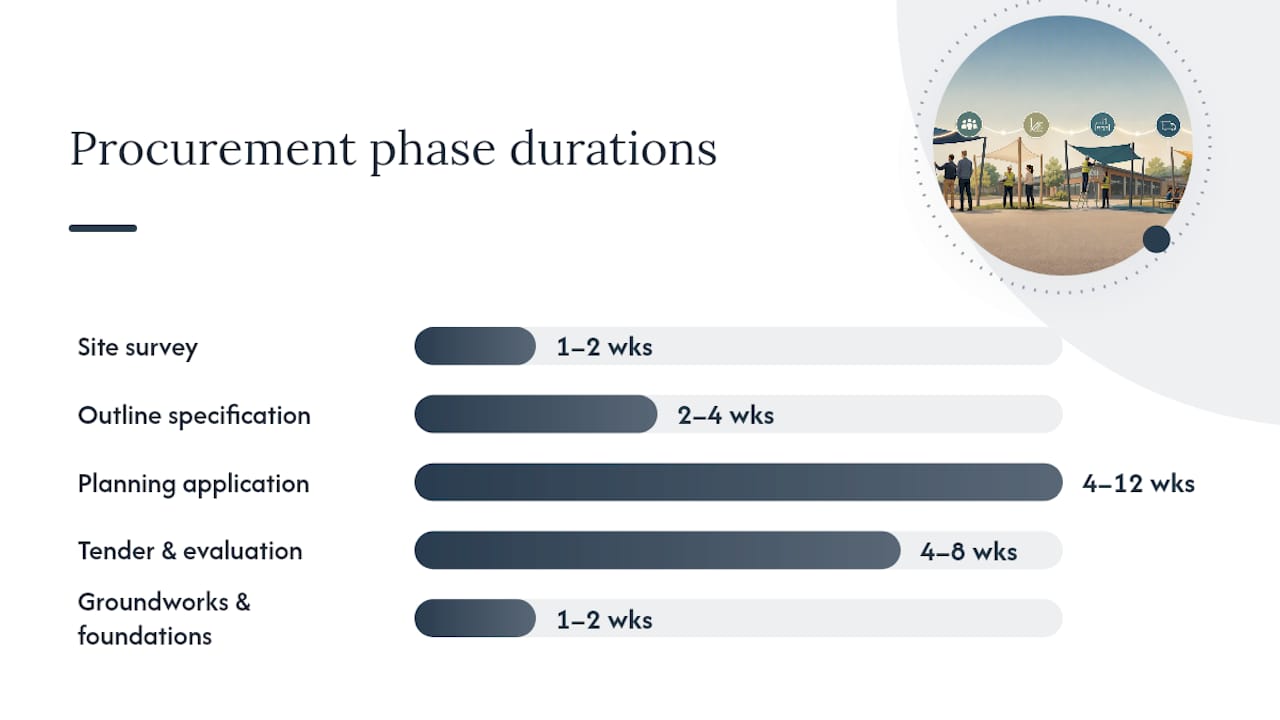
Suggested procurement timeline:
Site survey — commission a free survey to establish coverage area, soil conditions, access constraints and planning status (weeks 1–2)
Outline specification — agree coverage area, solution type, fabric spec, UPF and fire rating (weeks 2–4)
Planning application — submit if required; allow 8 weeks minimum (weeks 4–12)
Tender and evaluation — issue specification to shortlisted suppliers, evaluate against scoring criteria (weeks 4–8, running parallel to planning)
Groundworks and foundations — typically 1–2 weeks depending on soil and drainage (post-planning)
Structure installation — 2–5 days for most canopy or awning installations
Commissioning and handover — snagging, fabric tension checks, staff training on motorised systems, warranty documentation
Questions to ask suppliers during tender:
What brands do you supply and install (Weinor, Llaza, Selt, Tarasola, Morvelle)?
Can you provide references from school installations of comparable size?
What is your lead time from order to installation?
Who holds CDM responsibility and who is your structural engineer?
What does the warranty cover, and for how long?
What does your maintenance contract include, and what is the annual cost?
For detailed installation guidance, see how to install school awnings.
What maintenance schedule and budget should you plan for?
Planned maintenance significantly extends service life and protects warranty claims. A structure that is never inspected will fail earlier and void cover.
Typical maintenance schedule:
Termly: Visual check by site staff — look for fabric tears, loose fixings, drainage blockages and signs of corrosion on posts and brackets
Annual: Specialist inspection covering tension checks, motor servicing (if motorised), structural integrity and fabric UV assessment
Every 3–5 years: Deep clean of fabric and frame; re-tensioning of shade sails; lubrication of louvre mechanisms on pergolas
As needed: Reactive repairs to fabric damage, broken fixings or motor faults — budget a contingency of roughly 5–10% of capital cost per year
Warranty checklist — verify these before signing:
Fabric warranty covering UV degradation (typically 5–10 years depending on brand and fabric grade)
Structural warranty covering corrosion and weld integrity (typically 10–15 years for powder-coated steel)
Motorised component warranty (typically 2–5 years; check whether it covers call-out labour)
What voids the warranty — confirm cleaning products, modification restrictions and inspection requirements
Expected service lives: shade sails 7–12 years with proper winter storage; fixed canopies 20–25 years with annual inspection; retractable awnings 10–15 years depending on motor use and fabric grade. See school awning maintenance steps for a full inspection checklist.
What does a completed school shading project look like?
Infinityawnings has completed shading installations for educational sites across Yorkshire and the surrounding region, working with schools to specify structures that meet DfE passive design requirements, pass safeguarding reviews and hold up through term-time use.
A typical project brief involves a primary school seeking to cover a south-facing playground area of 60–80m² to extend outdoor learning into warmer months while managing overheating risk for the adjacent classroom block. The chosen solution is usually a fixed steel-framed canopy with a UPF 50+ fire-retardant tensile fabric, positioned to maintain full sightlines from the classroom exit. Groundworks are completed first, foundations are inspected, and the structure is installed within a single school week to minimise disruption.
What schools consistently report after installation:
Outdoor sessions running through weather that previously cancelled them
Staff confidence in supervising pupils outdoors, with sightlines confirmed in writing
Governors satisfied with a documented compliance trail referencing DfE guidance
The LOtC evidence summary supports embedding outdoor learning as whole-school practice — a covered space makes that ambition operationally realistic rather than weather-dependent.
Lessons from school projects:
Involve teaching staff in the sightline review, not just the estates team
Confirm underground services before groundworks begin — this is the most common cause of delay
Request fabric samples and test certificates before finalising the specification
What do typical UK school shading projects cost?
Budget ranges vary significantly by solution type, coverage area and groundworks complexity. The figures below are indicative starting points; a site survey is the only reliable route to an accurate cost.
Specification checklist to paste into your tender document:
Coverage area (m²) and zone description (playground, outdoor classroom, dining)
Minimum UPF rating: 50+
Fire standard: EN 13501-1 or equivalent; test certificate required
Structural calculations: signed by a chartered engineer
Warranty: minimum 10 years structural, 5 years fabric
Foundations: confirm soil survey and drainage plan included in scope
Accessibility: confirm clear headroom and unobstructed routes throughout
Maintenance plan: annual inspection schedule included in tender price
These ranges are ballpark figures based on typical UK school projects. Groundworks, access constraints, planning fees and bespoke design requirements will affect the final cost. Commission a site survey before committing to a budget.
What installers see go wrong — and how to avoid it
Most school shading projects that run into trouble share the same root cause: the brief was written without a site survey. Estates teams specify a coverage area from a floor plan, a supplier quotes accordingly, and then the groundworks reveal drainage runs, underground cables or a soil type that changes the foundation design entirely. The budget shifts, the timeline slips, and the relationship with the contractor starts badly.
The second most common problem is sightlines. A canopy that looks fine on a drawing creates a supervision blind spot in practice because the post positions were not reviewed against the actual teaching layout. Involve a member of the teaching staff in the sightline walkthrough before the design is finalised — it takes an hour and prevents a much larger problem.
Infinityawnings has spent over 15 years installing shading structures for schools and commercial sites across Yorkshire and the surrounding counties, working with brands including Weinor, Llaza, Selt, Tarasola and Morvelle. The projects that go smoothly are the ones where the client arrives with a clear brief, a realistic timeline that includes planning, and a willingness to let the site survey drive the specification rather than the other way around.
Infinityawnings school shading: survey to installation
Infinityawnings offers the full project journey for UK schools: free site survey, specification support, planning application assistance, groundworks, installation and ongoing maintenance contracts. For schools that have read the DfE guidance and need a supplier who can translate it into a compliant, installed structure, this is the practical next step.
Working with premium brands including Weinor, Llaza, Selt, Tarasola and Morvelle, Infinityawnings can specify the right fabric grade, UPF rating and structural system for your site, whether that is a retractable awning over a south-facing classroom exit, a louvred pergola for an outdoor teaching area, or a fixed tensile canopy over a main playground. Every installation comes with full warranty documentation and a maintenance plan your estates team can hand to governors.
Visit the school outdoor solutions page or contact Infinityawnings directly to book a free site survey and receive a no-obligation specification outline.
Sources
These are the primary references to save and include in your tender documentation:
Save PDFs of each source and attach them to tender documentation where governors or finance committees require an evidence base.
Recommended
Comments