
Sun protection for schools explained: a 2026 guide
- Andrew Crookes

- 6 days ago
- 7 min read

Why sun protection in schools matters more than you think
Schools have a legal duty of care to protect pupils and staff from UV radiation, and that obligation runs well beyond handing out a tube of sunscreen on sports day. Sun protection for schools is a multi-layered approach covering formal policy, curriculum education, physical environment changes, and staff training. The DfE statutory Health Education guidance requires schools to teach about the risks and benefits of sun exposure, making this a statutory matter, not a discretionary one.
Children’s skin is considerably more sensitive than adult skin, and repeated UV exposure in childhood raises the risk of skin cancer in later life. The Sun Safe Schools accreditation from the charity Skcin gives schools a recognised framework to formalise their approach across four steps: Protection, Education, Collaboration, and Accreditation. NICE endorses sun safety education as a public health priority, and NHS guidance sets the baseline standards schools should follow.
Key reasons to act now:
UV levels in the UK reach harmful levels from March to October, not just during heatwaves
Children spend a large proportion of their day outdoors during peak UV hours (11am–3pm)
A formal sun safety policy reduces legal liability as well as health risk
Sun safety sits within the statutory Health Education curriculum
“Take extra care to protect babies and children. Their skin is much more sensitive than adult skin, and damage caused by repeated exposure to sunlight could lead to skin cancer developing in later life.” — NHS
How to develop an effective sun safety policy in UK schools
There is no single nationally standardised policy template, but the DfE Health Education curriculum and Skcin’s Sun Safe Schools framework together provide a clear path. The starting point is treating sun safety as a safeguarding measure, not an optional health promotion exercise.
A well-written policy covers:
Protective clothing: relaxed uniform rules on hot days, wide-brimmed hats permitted or required
Sunscreen: clear guidance on pupil self-application, storage, and parental consent
Shade access: mapped outdoor areas with identified shaded zones
Timetabling: outdoor activities scheduled outside 11am–3pm where possible
Communication: annual letters to parents, staff briefings, and governor sign-off
The Sun Safe Schools four-step process (Protection, Education, Collaboration, Accreditation) gives schools a structured route to formalise all of this. Collaboration is often the step schools underestimate. Governors, school nurses, parents, and teaching staff all need to understand and own the policy, otherwise it sits in a drawer.
“A school sun safety policy is most effective when developed through consultation with all stakeholders, including governors, nurses, parents, and teachers, ensuring clarity and shared ownership.” — HES guidelines
Evaluate the policy at least once a year. Guidance from Skcin recommends annual reviews to keep pace with emerging evidence and any changes to NHS or DfE recommendations.
Sun safety education and resources for pupils
Teaching children about sun safety from early primary school builds habits that last a lifetime. Skcin’s research shows that early education on this topic is one of the most effective ways to reduce future skin cancer rates.
The 5 S’s of sun safety from the Sun Safe Schools programme give pupils a memorable framework:
Slip on a shirt or cover-up
Slop on SPF30+ sunscreen
Slap on a wide-brimmed hat
Seek shade, especially between 11am and 3pm
Slide on UV-protective sunglasses
Delivery works best when it goes beyond a single assembly. Weave the 5 S’s into PSHE lessons, science topics on UV radiation, and outdoor learning sessions. Skcin provides free downloadable lesson plans, assembly scripts, and pupil activity sheets through the Sun Safe Schools programme, all mapped to the national curriculum.
Parental engagement matters too. A short letter home at the start of the summer term, explaining the school’s sun safety expectations and asking parents to send children in with sunscreen, dramatically improves compliance. Keep the message simple: SPF30 minimum, applied before school, stored in the child’s bag.

Safeguarding and operational considerations for staff
Sun safety sits firmly within a school’s safeguarding framework. The GOV.UK guidance is clear that protecting children outdoors during hot weather is part of the duty of care, and failure to act carries both health and legal consequences.
The sunscreen question is where many schools get stuck. The National Education Union advises that teachers should not be required to apply sunscreen to pupils, but may do so with explicit parental consent. When staff do apply it, they should limit application to the face, neck, and arms, and record the consent. The cleaner solution is supervised self-application: pupils apply their own sunscreen under staff supervision, which removes most of the safeguarding complexity.
Practical operational steps:
Obtain written parental consent at the start of each academic year covering sunscreen use
Designate a supervised area for sunscreen application before outdoor sessions
Train all staff to recognise signs of sunburn and heat exhaustion (red skin, dizziness, nausea, confusion)
Keep a first aid protocol for heat-related illness visible in the staffroom
Ensure supply staff and cover teachers receive a briefing on the school’s sun safety policy
Staff training does not need to be lengthy. A 20-minute briefing at the start of the summer term, covering recognition and response, is enough to give all staff the confidence to act.
How shade structures reduce UV exposure on school grounds
Permanent shade structures provide far more reliable UV protection than natural tree cover or temporary gazebos. GOV.UK guidance specifically recommends permanent solutions such as verandas and awnings for consistent protection during peak UV hours.
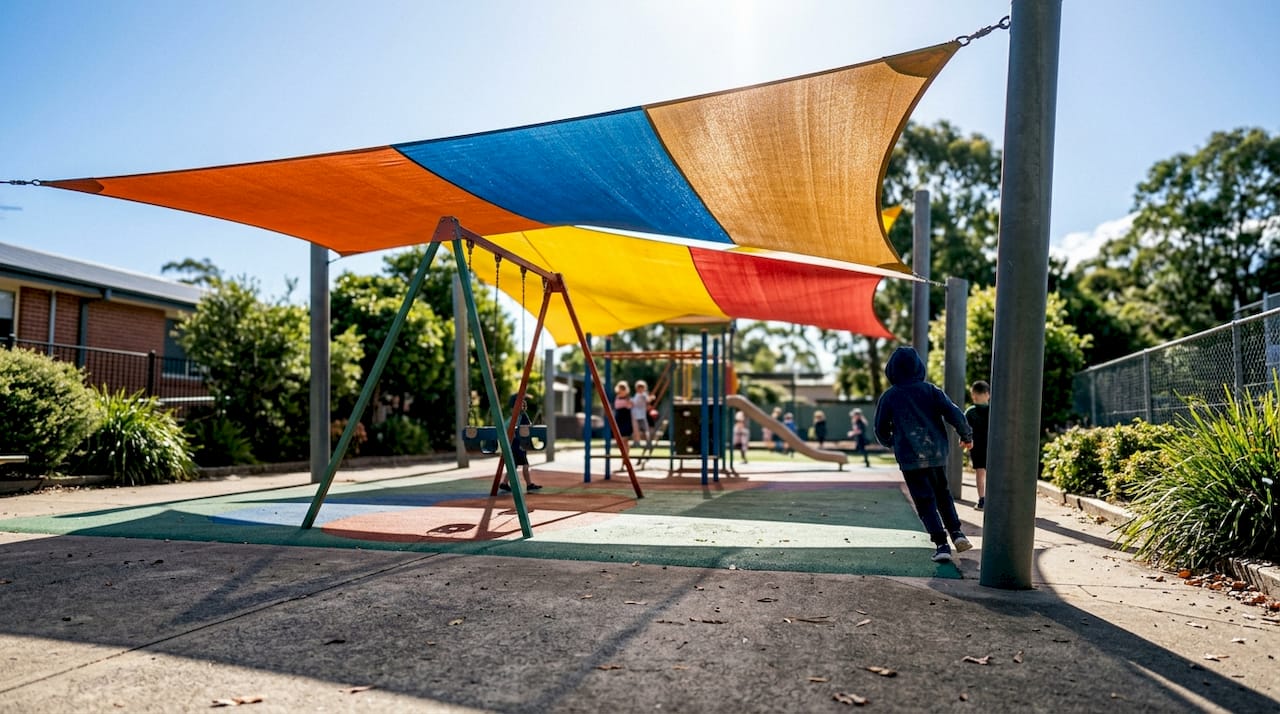
Start with an audit of your outdoor spaces. Walk the site between 11am and 1pm on a sunny day and note where children congregate: playgrounds, dining areas, sports pitches, and any outdoor classroom spaces. Those are your priority zones.
Shade structure options for schools:
Structure type | Best use | Key advantage |
Retractable awning | Playground edges, dining areas | Flexible, retractable in wind |
Fixed pergola | Outdoor classroom, seating areas | Year-round, architectural finish |
Veranda | Building-adjacent covered space | Weatherproof, extends usable area |
Sail shade | Large open areas | Cost-effective for wide coverage |
Timetabling adjustments complement physical shade. Scheduling outdoor activities outside the 11am–3pm window, extending morning breaks, and moving PE to early morning or late afternoon all reduce cumulative UV exposure without requiring any capital spend.
“Permanent shade structures provide reliable protection versus natural or temporary shade during peak UV hours.” — GOV.UK
Pro Tip: When commissioning a shade structure, ask the installer for the UV transmission rating of the fabric or material. A good canopy fabric blocks over 95% of UV radiation. Infinityawnings supplies pergolas and awnings specifically suited to school environments across Yorkshire, Derbyshire, Nottinghamshire, and Lincolnshire, with options that meet commercial durability requirements.
Schools should also consider exterior upgrades as part of a broader summer maintenance plan, since combining shade installation with other works often reduces disruption and cost.
Monitoring and evaluating sun protection policy effectiveness
A policy that never gets reviewed quickly becomes irrelevant. Set a fixed annual review date, ideally in February or March, before the UV season begins. The review should check whether the policy is being followed in practice, not just whether it exists on paper.
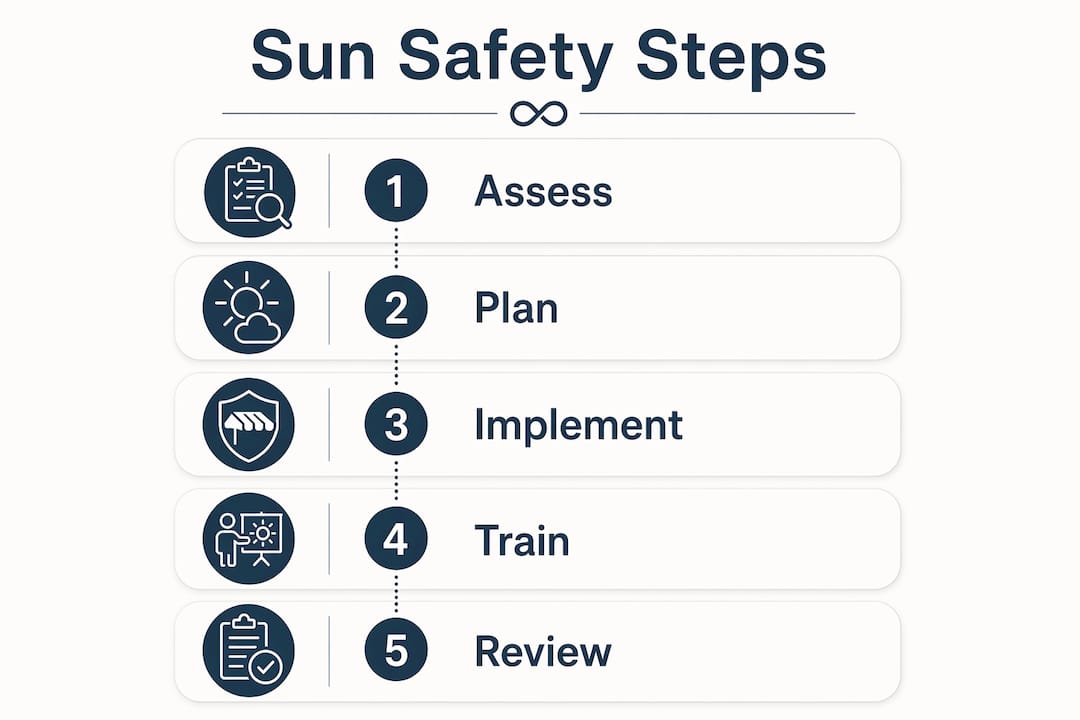
Useful indicators include: sunscreen consent return rates, staff training completion records, shade audit findings, and any reported incidents of sunburn or heat illness. If consent forms are coming back unsigned, that signals a communication gap with parents. If shade audits reveal uncovered zones, that points to a capital investment need.
Skcin’s Sun Safe Schools accreditation process builds evaluation in from the start. Schools working towards or maintaining accreditation have a natural annual checkpoint that keeps the policy live and visible to the whole school community.
Choosing the right sunscreen for school use
NHS guidance sets the minimum standard clearly: SPF 30 or higher, with at least a 4-star UVA rating. Anything below that threshold does not provide adequate protection for children spending extended time outdoors.
Application matters as much as the product itself. Sunscreen applied once in the morning and not reapplied offers limited protection by lunchtime. The NHS recommends reapplication every 2 hours, and after any activity involving water or heavy sweating. For a school day, that means at least one reapplication around midday.
Practical guidance for schools:
Ask parents to apply sunscreen before the school day starts
Store pupils’ named sunscreen bottles in a cool, accessible location
Use a broad-spectrum, fragrance-free formula to reduce the risk of skin reactions
Avoid spray formulations for young children; lotions and creams are easier to apply evenly
Integrating sun protection with wider health and wellbeing policies
Sun safety works best when it sits inside the school’s broader health and wellbeing framework rather than as a standalone document. Link it explicitly to the PSHE programme, the outdoor learning policy, the first aid policy, and any existing heat management plans.
The DfE’s statutory Health Education curriculum already requires teaching about sun exposure, so the educational component has a natural home. The physical and environmental measures connect directly to facilities management and the school development plan. Framing sun protection as part of whole-school wellbeing, rather than a seasonal add-on, is what gives it staying power year after year.
Key takeaways
UK schools that treat sun protection as a safeguarding priority, backed by formal policy, staff training, curriculum education, and permanent shade structures, give pupils the most complete protection against UV harm.
Point | Details |
Statutory requirement | The DfE requires sun safety teaching within the statutory Health Education curriculum. |
Sunscreen standard | Use SPF 30+ with 4-star UVA protection; reapply every 2 hours and after swimming or sweating, following NHS guidance. |
Peak UV hours | Schedule outdoor activities outside 11am–3pm from march to october to reduce exposure. |
Permanent shade | Fixed structures such as pergolas and awnings provide more reliable UV protection than temporary alternatives. |
Annual policy review | Review and update the sun safety policy each year, ideally before the UV season begins in spring. |
Shade structures for your school from Infinityawnings

Infinityawnings designs and installs permanent shade structures built for school environments, including retractable awnings, pergolas, and verandas across Yorkshire, Derbyshire, Nottinghamshire, and Lincolnshire. Every installation is tailored to the site, with commercial-grade materials that meet the durability demands of a busy school setting.
If your school is ready to invest in permanent playground shading or a covered outdoor learning area, Infinityawnings offers free consultations and bespoke quotes. Explore the full range of school pergola options or get in touch to discuss what your site needs.
Recommended
Comments