
Why use architectural shading for your property

TL;DR:
Architectural shading devices, such as overhangs and pergolas, intercept solar radiation, reducing heat gain and enhancing comfort. External shading outperforms internal solutions by blocking heat at the facade, lowering cooling demands by up to 85%, and stabilizing indoor microclimates. Proper device selection depends on facade orientation and seasonal control needs, with dynamic solutions offering year-round benefits and increased property value.
Architectural shading is defined as any external or integrated device that intercepts solar radiation before it reaches a building’s glazing, reducing heat gain and improving occupant comfort. The term covers a broad family of solutions, from fixed overhangs and louvres to dynamic bioclimatic pergolas and brise-soleils. External shading reduces cooling load by 60 to 85%, depending on the device type, and can lower indoor temperatures by up to 18°C in the UK climate. For homeowners and businesses weighing the benefits of architectural shading, those numbers represent a genuine shift in how usable and comfortable a building feels throughout the year.
Why use architectural shading to reduce solar heat gain
The physics behind shading is straightforward. Solar radiation passes through glass and converts to heat inside a room, a process measured by the Solar Heat Gain Coefficient (SHGC). The lower the SHGC, the less heat enters. External shading devices attack the problem at the facade, before radiation ever touches the glass.
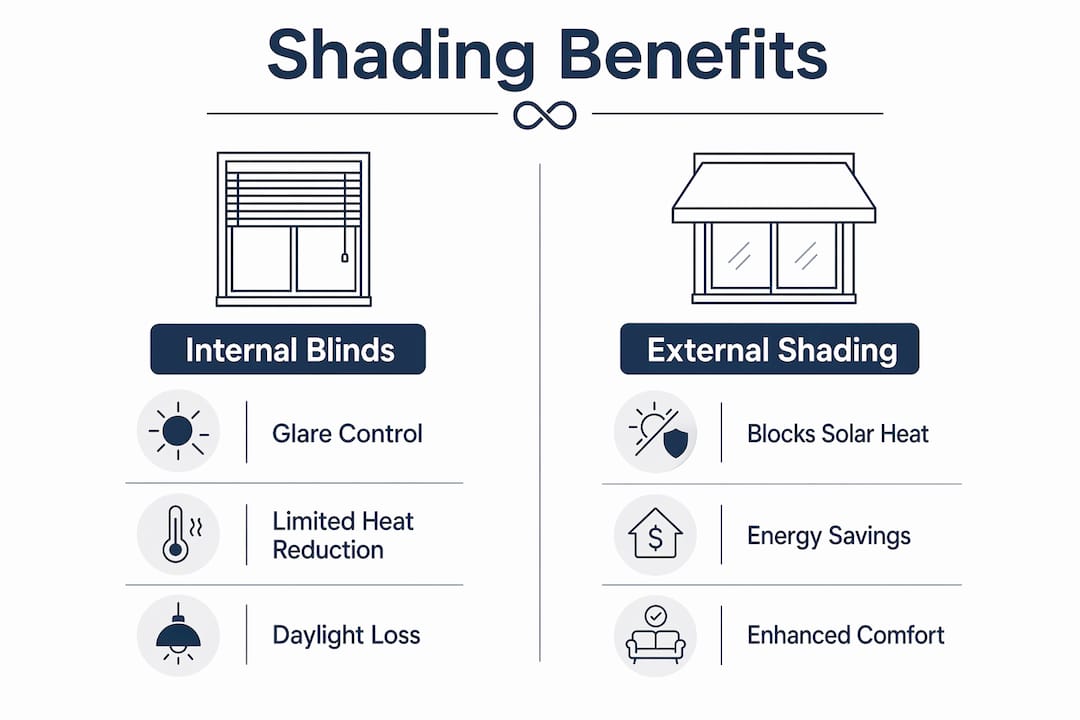
This is the critical distinction between external shading and internal blinds. Internal blinds reduce glare but do not prevent heat from passing through the glazing. The heat is already inside the room by the time a blind intercepts the light. External devices such as overhangs, canopies, and louvres stop that energy at source, which is why they consistently outperform internal solutions on thermal comfort.
The performance gap is significant. A well-designed shading device reduces solar heat gain through glazed openings by 50 to 80% compared with unshaded glazing. That reduction translates directly into lower demand for mechanical cooling, which means lower energy bills and a smaller carbon footprint.
Key mechanisms that make external shading so effective:
Radiation interception at the facade. Heat is blocked before it enters the thermal envelope, preventing the greenhouse effect inside glazed spaces.
Reduced peak cooling load. Cutting solar gain at peak hours reduces the size of air conditioning plant required, or removes the need for it entirely.
Stabilised indoor microclimate. External shading stabilises indoor microclimate better than internal shading, reducing peak discomfort in highly glazed spaces.
Daylight retention. Unlike opaque internal blinds, well-specified external devices can preserve views and diffuse daylight while controlling heat.
Pro Tip: When specifying shading for a south-facing glazed extension, prioritise external overhangs or a retractable awning over internal roller blinds. You will achieve far greater temperature control without sacrificing natural light.
What types of architectural shading suit different buildings?
Choosing the right shading device depends on facade orientation, building style, and how much flexibility you need across seasons. Each device type has a distinct performance profile.
Shading type | Best orientation | Pros | Cons | Typical heat gain reduction |
Fixed overhang | South-facing | Low maintenance, passive | Limited seasonal adjustment | 40–60% |
Adjustable louvres | East and west | Flexible, high control | Higher cost, mechanical parts | 60–80% |
Retractable awning | South and west | Seasonal flexibility, stylish | Requires manual or motor operation | 50–75% |
Brise-soleil screen | Any | Architectural statement, durable | Fixed position limits winter sun | 50–70% |
Bioclimatic pergola | Any | Year-round use, integrated design | Premium investment | 60–85% |
Orientation is the single most important factor in device selection. Horizontal overhangs work well on south-facing facades because the summer sun sits high in the sky and a horizontal projection blocks it effectively. On east and west elevations, the sun is lower and more oblique, so vertical fins or adjustable louvres perform better.
Dynamic solutions such as bioclimatic pergolas, offered by brands including Weinor and Tarasola, add another layer of control. Adjustable roof blades open to admit winter sun and close to block summer heat, giving year-round comfort from a single structure. For businesses such as restaurants and hotels, this flexibility extends outdoor seating seasons considerably.
Exterior shading types and design considerations vary significantly between residential and commercial settings. A homeowner adding a veranda to a rear extension has different priorities from a hotel fitting a canopy over a south-facing terrace, but both benefit from matching device type to orientation and use pattern.
Pro Tip: For east and west-facing glazing, adjustable louvres or vertical fins give you far more control than a fixed horizontal overhang. The low-angle morning and evening sun requires a different geometry entirely.
How do you balance cooling, heating, and daylight with shading?
The most common misconception about architectural shading is that more depth always means better performance. The relationship is more nuanced, and getting the balance wrong can create problems in winter.
Research on passive solar houses shows that increasing fixed shading depth can cut cooling energy by over 50%, but may simultaneously increase heating energy demand by up to 16%. The net result is still positive, with total annual energy savings reaching up to 26%, but the trade-off matters for buildings in colder climates or those relying on passive solar gain in winter. For UK properties, where heating seasons are long, oversized fixed shading can work against you from October through to March.
Shading depth | Summer cooling saving | Winter heating increase | Net annual saving |
Shallow (600mm) | ~20% | ~4% | ~16% |
Medium (900mm) | ~35% | ~9% | ~26% |
Deep (1200mm+) | ~50% | ~16% | ~26–34% |
Daylight is the other variable that demands attention. External shading may reduce useful daylight by 15 to 25%, which affects both comfort and the need for artificial lighting. The mitigation is straightforward: specify semi-transparent or perforated shading materials that control heat while transmitting diffuse light. Fabrics used in quality retractable awnings from brands such as Selt and Llaza are engineered precisely for this balance.
Designers should consider annual solar admission and seasonal sun paths rather than sizing shading geometry around a single worst-case sun position. A shading device optimised only for the summer solstice will underperform in spring and autumn, and may block too much winter sun. Integrated facade design, combining shading with appropriate glazing specification and thermal mass, produces the most consistent year-round results.
Pro Tip: If you are retrofitting shading to an existing building, use a sun path diagram for your specific latitude to check the shading angle at both the summer solstice and the spring and autumn equinoxes before committing to a fixed depth.
What are the practical benefits of architectural shading for homeowners and businesses?
The advantages of shading systems extend well beyond the physics of heat control. For homeowners and business owners, the practical case rests on four interconnected benefits.
Comfort that you can feel immediately. In the UK, external shading reduces indoor temperatures by up to 18°C, a figure that transforms a south-facing conservatory or glazed office from an unusable hot box into a comfortable working and living space. That improvement requires no mechanical cooling at all.
Lower energy costs and reduced carbon output. Cutting cooling load by 60 to 85% reduces reliance on air conditioning. For commercial properties such as restaurants and hotels, where cooling plant runs for extended periods, the financial saving is material. For residential properties, it removes the need for air conditioning entirely in many cases, which also eliminates the associated installation cost.
Extended outdoor usability. Pergolas, verandas, and canopies create sheltered outdoor zones that function in rain, wind, and direct sun. For hospitality businesses, this directly increases revenue-generating floor space. For homeowners, it converts a garden into a usable room for a greater part of the year. You can explore the full range of UK outdoor shading benefits for residential properties in more detail.
Architectural identity and property value. Solar shading contributes to architectural identity through dynamic facade conditions, not just functional performance. A well-specified bioclimatic pergola or brise-soleil becomes a design feature that enhances kerb appeal and, in many cases, adds measurable value to the property. Pairing shading with energy-efficient glazing amplifies both the thermal and aesthetic result.
Key takeaways
Architectural shading delivers its greatest value when external devices are matched to facade orientation, sized for seasonal balance, and integrated with glazing and thermal mass from the outset.
Point | Details |
External beats internal | External shading blocks heat at the facade; internal blinds only reduce glare after heat has entered. |
Cooling load reduction | Well-specified external shading cuts solar heat gain by 50 to 85%, reducing or eliminating mechanical cooling needs. |
Seasonal balance matters | Fixed shading depth above 900mm can increase winter heating demand by up to 16%; adjustable devices avoid this trade-off. |
Daylight trade-off is manageable | Semi-transparent or perforated shading materials maintain useful daylight while controlling heat gain. |
Comfort and value combined | Shading reduces indoor temperatures by up to 18°C and enhances architectural identity, supporting both comfort and property value. |
Andrew’s view: shading is not optional any more
I have spent well over a decade specifying and installing shading solutions across Yorkshire, Derbyshire, and Lincolnshire, and the conversation with clients has changed markedly in the last three or four years. Homeowners who once asked whether they needed shading now ask which type they should choose. That shift reflects something real: UK summers are hotter, glazed extensions are more common, and the cost of running air conditioning has made passive solutions far more attractive.
What still surprises me is how many people underestimate the importance of orientation. I regularly see fixed overhangs installed on east-facing walls, where they do almost nothing useful, or deep canopies on north-facing facades where solar gain was never the problem. The device type must follow the sun path, not the other way around.
The other misconception I encounter is that shading is a summer-only consideration. A bioclimatic pergola with adjustable louvres, or a quality retractable awning from a brand like Weinor, gives you year-round control. You open it in winter to admit low-angle sun and close it in summer to block overhead heat. That flexibility is where the real value lies, and it is why I always recommend dynamic solutions over fixed ones for residential clients who want the best of both seasons.
Shading is climate-adaptation infrastructure. The Building Better Health and Sustainability Alliance frames external shading as a priority adaptation for rising overheating risks in the UK. I agree entirely. Treating it as an optional aesthetic upgrade is a mistake that becomes more expensive to correct every year.
— Andrew
Explore pergolas and shading solutions from Infinityawnings
Infinityawnings designs, supplies, and installs architectural shading solutions across Yorkshire, Derbyshire, Nottinghamshire, and Lincolnshire, with over 15 years of experience matching the right product to each property. Pergolas are among the most popular choices for homeowners and businesses seeking year-round outdoor comfort, combining the solar control of a fixed structure with the flexibility of adjustable louvres or retractable canopies. Browse the full range of garden pergolas from Infinityawnings to find a solution that suits your facade orientation, outdoor space, and design preferences. Free quotes and expert guidance are available for every project.
FAQ
What is architectural shading?
Architectural shading refers to external or integrated devices, such as overhangs, louvres, canopies, and pergolas, that intercept solar radiation before it reaches a building’s glazing. The purpose is to reduce solar heat gain, lower indoor temperatures, and improve occupant comfort.
Why is external shading better than internal blinds?
External shading blocks heat at the facade before it enters the building, whereas internal blinds only reduce glare after heat has already passed through the glass. This distinction means external devices are far more effective at preventing overheating.
How much can architectural shading reduce cooling costs?
External shading reduces cooling load by 60 to 85% depending on device type and orientation, which significantly lowers or eliminates the need for mechanical air conditioning in residential and commercial properties.
Does shading reduce natural light inside a building?
External shading can reduce useful daylight by 15 to 25%, but specifying semi-transparent or perforated materials mitigates this loss while still controlling heat gain effectively.
Which shading device is best for a south-facing property?
A horizontal overhang, retractable awning, or bioclimatic pergola suits south-facing facades best, as the high summer sun angle allows a horizontal projection to block direct radiation while admitting lower winter sun when the device is retracted or adjusted.
Recommended
Comments