
Exterior shading terminology: a clear guide

TL;DR:
Proper understanding of exterior shading terminology helps prevent miscommunication, saving time and money. It ensures compliance with regulations by accurately specifying performance thresholds like 80% solar radiation blockage. Clear differentiation between forms, control methods, and performance metrics leads to better project outcomes and informed decision-making.
Getting exterior shading terminology wrong costs you. It costs time when your supplier quotes something entirely different from what you pictured. It costs money when a product fails a building regulation check because you used the wrong term. And it costs comfort when a shade screen that seemed ideal on paper turns out to let through far more heat than you expected. Whether you are a homeowner in Yorkshire planning a pergola or a commercial specifier sourcing compliant external shading devices, understanding the correct outdoor shading concepts is the foundation of every good decision.
Table of Contents
Key takeaways
Point | Details |
Terminology shapes outcomes | Using the correct shading device definitions prevents misspecification and builds clearer supplier dialogue. |
Form, control, and performance are separate layers | Confusing these three layers is the most common source of errors in shading projects. |
Compliance depends on measurable thresholds | A shading device must block at least 80% of summer solar radiation to qualify under commercial energy codes. |
Materials carry their own vocabulary | Terms like openness factor and acrylic canvas directly affect how well a solution performs in practice. |
Adaptive shading has its own terminology | Kinetic and motorised systems require understanding of actuators, slat angle, and daylight performance metrics. |
Core exterior shading forms and types
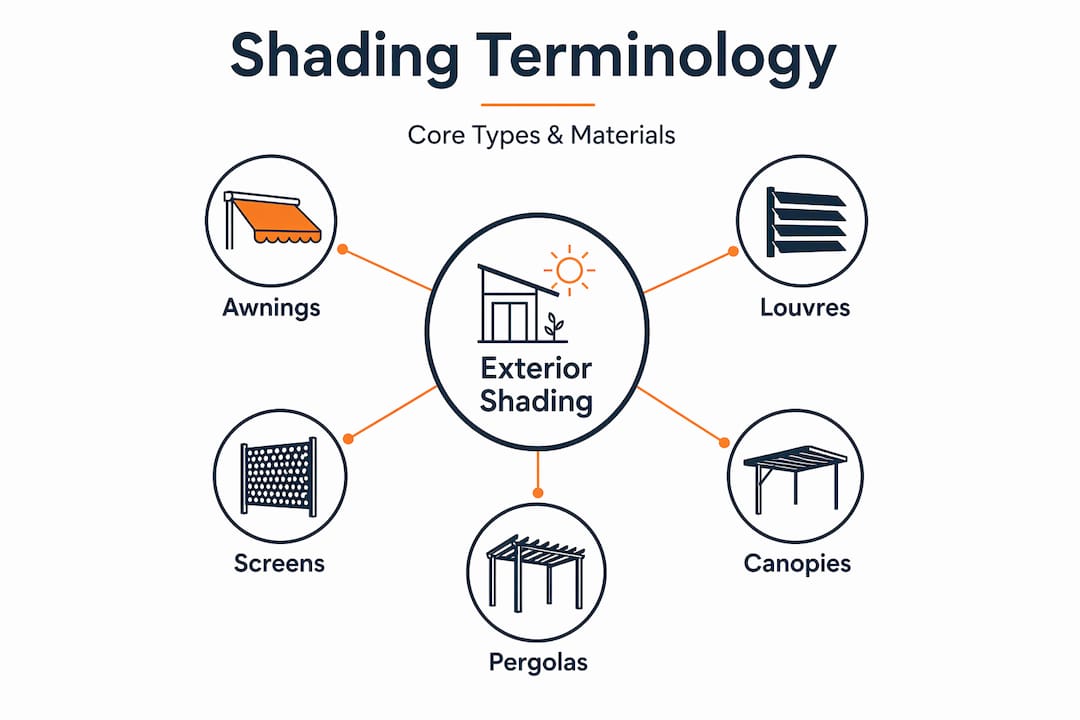
The confusion in exterior shading terminology often starts with the names of the products themselves. “Awning”, “canopy”, “shade sail”, and “pergola” are frequently used interchangeably in casual conversation, but each describes a distinct structural form with different performance characteristics.
Awnings are secondary coverings made from canvas fabrics stretched over metal or lightweight frameworks. They project outward from a wall or roof edge, providing shade to the window or outdoor area beneath. Structurally, an awning uses an aluminium or steel understructure, and the fabric itself is typically acrylic, polyester, or vinyl laminated to polyester. A retractable awning can fold back when not in use. A fixed or stationary awning cannot.
Shade screens are a distinct product altogether. Unlike interior blinds, exterior screens block solar energy before it passes through the glass. That positioning matters enormously for heat gain. A fitted exterior solar screen stops radiation at the building envelope. An interior blind reduces glare after the heat has already entered the room.
Louvers and slats are terms that get confused regularly. The distinction is worth knowing precisely:
Louvre refers to the entire system of angled blades used to control light, airflow, and water.
Slat refers to an individual blade within that system.
Louvered systems can be fixed (set at a permanent angle) or adjustable (motorised or manual), commonly used in pergola roofs, screens, and window surrounds.
Pergola describes a freestanding or wall-attached outdoor structure, typically with an open or partially covered roof. When fitted with a louvred roof, it becomes an adjustable shading structure.
Shade sail refers to a tensioned fabric panel attached at multiple anchor points. It is a semi-permanent structure rather than a retractable one.
Pro Tip: When speaking with a supplier or specifier, always clarify whether you mean “louvre” as the system or as a single blade. Getting this wrong is one of the most frequent causes of misquotation in commercial shading projects.
Terminology also extends to how materials are described. “Solution-dyed acrylic” is a fabric term you will encounter often. It refers to a process where colour pigment is added during fibre production rather than applied afterwards, resulting in better UV resistance and colour stability over time.
Performance and compliance terminology
This is where exterior shading terminology moves from descriptive to technical, and where precision matters most for commercial and energy-compliant projects.

The term external shading device has a specific regulatory meaning. Under codes such as the Australian National Construction Code (referenced widely in international compliance literature), a shading device must restrict at least 80% of summer solar radiation to qualify formally. This is not a marketing category. It is a performance threshold. Calling a product a “shading device” in a specification document carries legal and regulatory weight in many contexts.
The second critical distinction is between fixed and adjustable shading devices, and within adjustable, between manual and automatic control.
Category | Description | Commercial requirement |
Fixed shading device | Set position, no user adjustment | Must meet radiation restriction threshold by design geometry |
Adjustable (manual) | User-operated, no automation | May be acceptable in residential; less often in commercial |
Adjustable (automatic) | Sensor or timer-driven actuation | Required for commercial compliance in many jurisdictions |
Motorised | Electrically driven, often with remote or smart control | Common standard for quality commercial installs |
Understanding this table helps you communicate intent clearly. If you specify “adjustable shading” without clarifying manual or automatic, your contractor and your building inspector may each assume something different.
The term solar radiation appears throughout shading specifications. For practical purposes, it refers to the total heat energy from the sun reaching a surface, measured in watts per square metre. Solar heat gain coefficient (SHGC) is a related term you will encounter in glazing and window shade specifications. A lower SHGC means less heat enters through the glass.
Pro Tip: When reviewing a product’s technical datasheet, always look for the tested solar radiation restriction percentage rather than relying on manufacturer descriptions. Terms like “high performance” and “solar control” are marketing language. The percentage figure is what counts for compliance and for energy efficiency gains.
Terminology precision is non-negotiable when energy compliance is involved. A product that performs at 75% solar radiation restriction does not meet the 80% threshold, regardless of what its marketing copy says.
Functional shading concepts and control mechanisms
Once you move beyond form and into function, exterior shading terminology takes on another layer entirely. This is where adaptive and kinetic systems come in, and where many people encounter terms they have not seen before.
Adaptive shading refers to systems that respond to changing conditions, whether that is the angle of the sun, ambient temperature, or user preference. Kinetic shading is a subset of adaptive shading, specifically describing systems where physical components move dynamically in response to input. Kinetic shading systems reduce glare substantially while enabling better use of available natural daylight compared to fixed solutions.
Key terminology within this category includes:
Actuator: the mechanical component that drives movement in a motorised shading system. Electric actuators are standard in high-quality louvred pergolas and retractable awnings.
Slat or louvre angle: the precise tilt of individual blades within an adjustable louvred system. Measured in degrees, this directly controls how much sunlight passes through and in which direction.
Daylight glare probability (DGP): a metric used in technical and architectural specifications to describe how likely a shading configuration is to cause visual discomfort. You will see this in commercial office and educational building specifications.
Veiling luminance: the brightness of a light source or reflected glare that obscures visibility. In shading contexts, it is used to evaluate how well a screen or louvre system controls reflective glare from external surfaces.
Openness factor: the percentage of a shade screen mesh that is open space rather than fibre. A 3% openness factor blocks more light and provides more privacy than a 10% factor.
These terms reflect both mechanical performance and environmental outcome. When a manufacturer describes a motorised louvred pergola as having “dynamic daylight management,” they are referring to this combination of actuator control and DGP reduction. Knowing the underlying terms helps you evaluate whether the claim is measurable or just marketing.
Material and design terminology
Materials underpin every exterior shading product, and their terminology connects directly to performance outcomes. Understanding these terms helps you read specifications accurately and ask the right questions.
Material term | What it means in practice |
Solution-dyed acrylic | Colour-stable fabric with strong UV resistance; standard for premium awning canopies |
Polyester with vinyl laminate | More waterproof than acrylic; used where water resistance is prioritised |
Aluminium frame | Lightweight, corrosion-resistant structure for awnings, louvres, and pergola frames |
Solar mesh / solar screen fabric | Open-weave material rated by openness factor; designed for exterior screen applications |
Powder coating | A heat-applied finish on metal frames providing weather and scratch resistance |
Mesh openness factor and fabric colour are two of the most practically significant material terms. A lower openness percentage blocks more sun and reduces outward visibility from inside. Darker coloured mesh improves your view from inside to outside whilst lighter colours reflect more solar heat. This is not intuitive, and it trips up buyers frequently.
Fixed frame screens are mounted in a permanent frame attached to the building. Frameless screens use tension systems or roller mechanisms. The distinction matters because it affects installation complexity, the ability to open windows or doors behind the screen, and the visual appearance from outside.
Pro Tip: When specifying a solar screen, always request the openness factor as a percentage alongside the colour. A phrase like “3% charcoal mesh” gives you both the performance specification and the visual outcome in four words. That is the level of precision worth aiming for in any shading specification.
Applying terminology confidently in practice
Mastering exterior shading terminology is only useful if you can apply it clearly when it counts. That means when you are briefing a supplier, comparing quotes, or reviewing a product specification.
Several practical habits will help you avoid the most common mistakes:
Always separate the three layers: form (what the product is), control (how it operates), and performance (what it measurably achieves). Exterior shading terminology covers all three, and conflating them leads to unclear briefs.
When requesting quotes, specify the product type, the operation type (manual, motorised, automatic), and the required solar radiation restriction percentage as separate line items.
Ask for the openness factor and fabric specification in writing, not just the product name.
Check whether warranty terms use the terms you expect. A warranty on “the frame” may not cover the fabric, and vice versa.
For commercial projects, confirm whether the product meets the ≥80% solar radiation threshold and whether automatic operation is required for code compliance in your context.
You can explore the full range of shading types available in the UK to see how these terms map onto real products. Knowing the vocabulary means you spend less time correcting misunderstandings and more time making decisions you feel confident about.
My experience with shading terminology on real projects
Over years of working with exterior shading across residential and commercial projects, the same pattern emerges repeatedly. A client or specifier uses a term loosely, a supplier interprets it differently, and two weeks later someone is paying to change something that was never right to begin with.
I have seen “louvred pergola” used to mean anything from a fixed timber structure to a fully motorised aluminium system with integrated sensors. Both descriptions are technically defensible. Neither is useful without the additional vocabulary that specifies materials, control type, and performance metrics.
What I have found genuinely useful is treating shading terminology as three separate conversations. First, you agree on the form. Second, you agree on the control mechanism. Third, you agree on what the product needs to achieve in measurable terms. When those three conversations happen in sequence rather than all at once, specification errors drop dramatically.
The terms around kinetic and adaptive shading are particularly worth understanding even if you are not specifying a complex commercial system. Knowing that a motorised louvred roof is, by definition, an adaptive shading device helps you understand why it costs more and what you are paying for. It is not a luxury upgrade. It is a measurably different product category with performance characteristics that a fixed canopy simply cannot replicate.
My advice: write down your shading requirement using the three-layer framework before you speak to anyone. Form. Control. Performance. You will walk into that conversation sounding like you know exactly what you need. Because you will.
— Andrew
Explore Infinity Awnings’ shading solutions
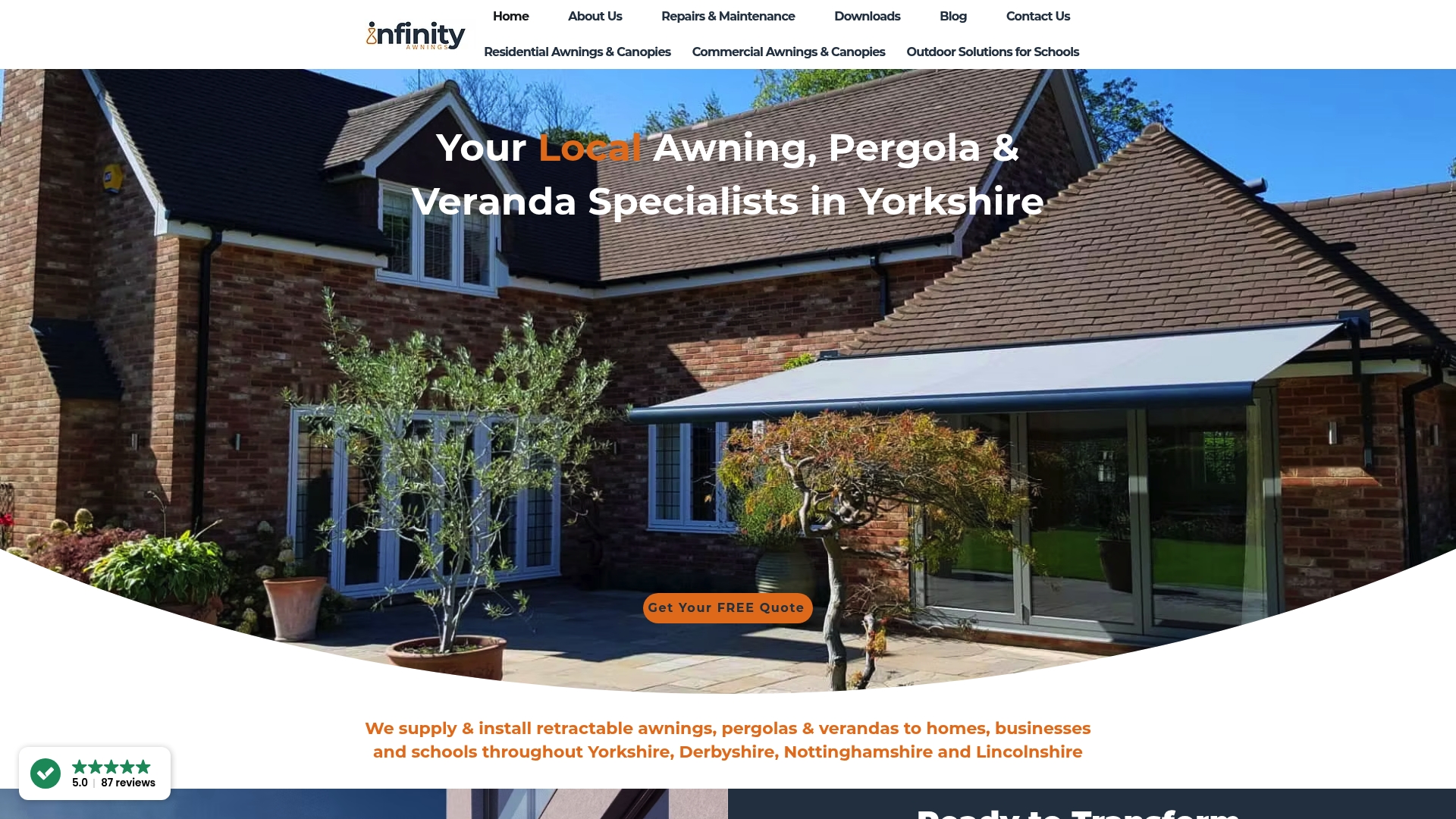
Understanding exterior shading terminology is the first step. Seeing those terms applied to well-engineered products is the next. Infinityawnings has spent over 15 years specifying, supplying, and installing shading solutions across Yorkshire, Derbyshire, Nottinghamshire, and Lincolnshire, working with premium brands including Weinor, Tarasola, and Llaza. Whether you are looking for a motorised louvred pergola, a retractable awning, or a fixed veranda, the team can match your performance requirements to the right product. Take a look at the full range of garden pergola solutions or get in touch for a free, no-obligation quote tailored to your space and specification.
FAQ
What is an external shading device?
An external shading device is a product mounted outside a building that restricts solar radiation from entering through windows or the building envelope. To qualify as a shading device under commercial energy codes, it must block at least 80% of summer solar radiation.
What does openness factor mean in shading terminology?
Openness factor is the percentage of a shade screen’s surface area that is open weave rather than solid fibre. A lower percentage, such as 3%, blocks more sunlight and provides more privacy than a higher percentage such as 10%.
What is the difference between a louvre and a slat?
A slat is a single adjustable blade within a shading system. A louvre refers to the complete assembly of multiple slats, including the frame and control mechanism. Louvered systems can be fixed or adjustable and are widely used in pergola roofs and exterior screens.
What does adaptive or kinetic shading mean?
Adaptive shading describes systems that adjust their position or angle in response to changing conditions. Kinetic shading is a form of adaptive shading where physical components move dynamically. These systems use actuators to alter slat angles, improving both daylight use and glare control.
Why does exterior shading block more heat than interior shading?
Exterior shading intercepts solar radiation before it reaches the glass, preventing heat from entering the building entirely. Interior shades, such as blinds or curtains, reduce glare but cannot prevent the heat that has already passed through the window from warming the room.
Recommended
Comments