
Why use LED lighting outdoors: a homeowner's guide

TL;DR:
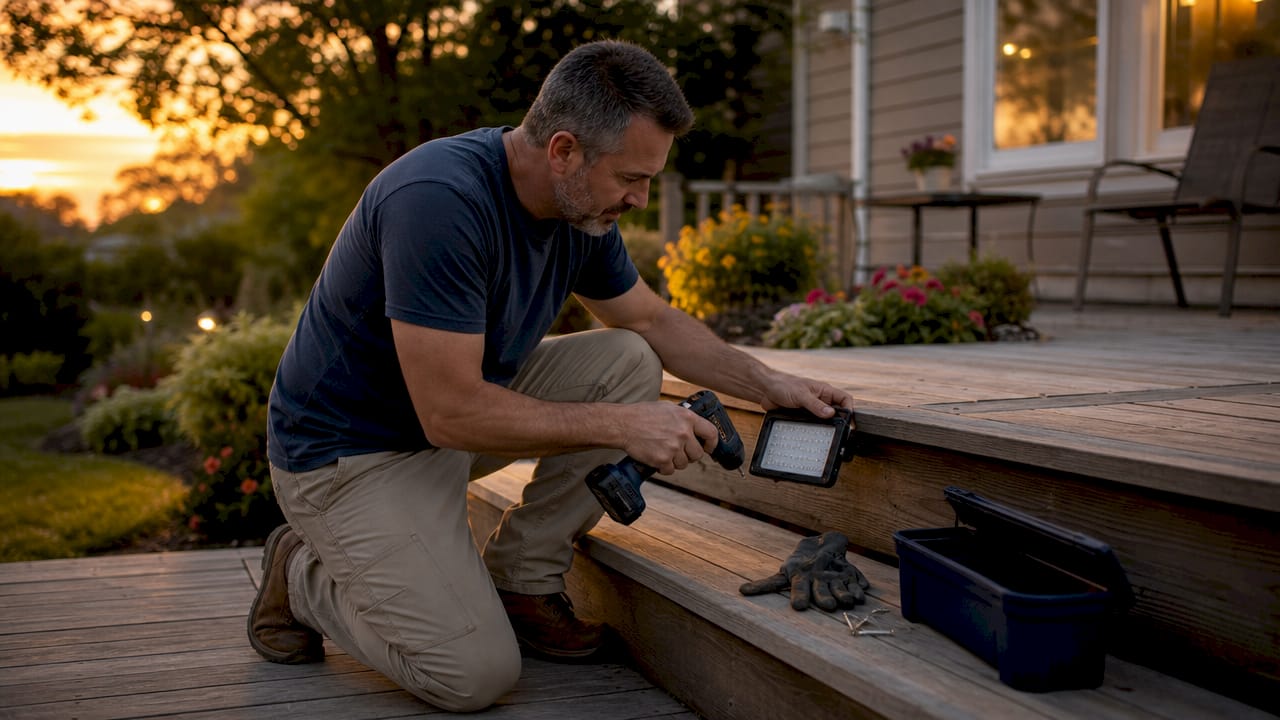
Outdoor LED lighting provides significant energy savings, lasting up to 50,000 hours and performing well in low temperatures. It also offers enhanced durability, reduce maintenance costs, and enables flexible, aesthetically pleasing outdoor designs. Switching to LED lights makes outdoor spaces safer, more attractive, and environmentally responsible.
LED outdoor lighting is defined as the use of light-emitting diode technology to illuminate exterior spaces, and it is the most energy-efficient, long-lasting, and versatile option available to homeowners today. Whether you are lighting a patio, pathway, garden feature, or pergola, the benefits of outdoor LED lighting are clear and well-supported by bodies including the U.S. Department of Energy. LEDs use at least 75% less energy than incandescent bulbs and last up to 25 times longer. That combination of savings and durability makes understanding why use LED lighting outdoors one of the most practical questions any homeowner can ask.
Why use LED lighting outdoors: the energy efficiency case
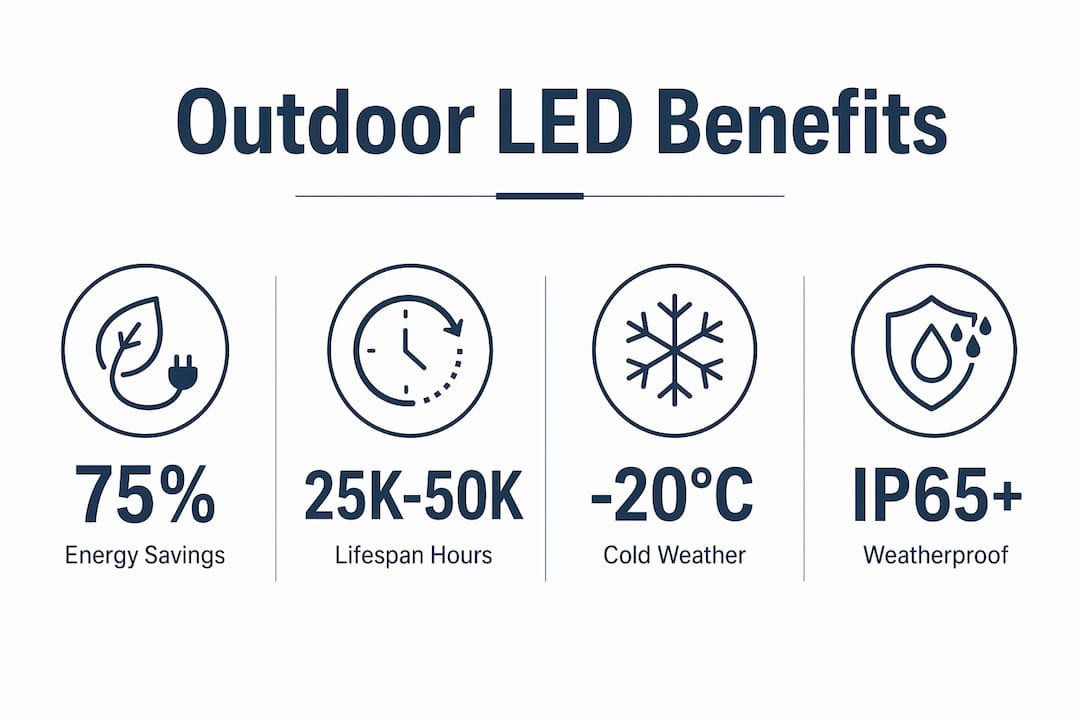
The energy efficiency of LED lights is the single strongest reason to switch your outdoor setup. The U.S. Department of Energy confirms that residential LED products use at least 75% less energy than incandescent lighting, saving an average household around £225 annually. That figure is not trivial. For outdoor spaces where lights often run for hours each evening, the cumulative saving across a year is significant.
LEDs achieve this efficiency through directional light output. Traditional bulbs emit light in all directions, meaning a large proportion is lost inside the fixture itself. The Department of Energy notes that traditional lighting can lose over 50% of its light internally. LEDs project light precisely where it is needed, so less energy is wasted and fixtures can be smaller and less obtrusive.
Instant full brightness is another efficiency advantage. Older fluorescent and high-pressure sodium outdoor lights require a warm-up period before reaching full output. LEDs reach full brightness the moment they are switched on. This matters particularly for motion-activated garden or driveway lights, where any delay defeats the purpose entirely.
Smart controls extend the savings further. The International Energy Agency confirms that smart lighting controls, including occupancy sensors and daylight sensors, can significantly reduce energy use in outdoor lighting. Pairing LEDs with a timer or a dusk-to-dawn sensor means your lights only run when genuinely needed.
Pro Tip: Choose ENERGY STAR-qualified outdoor LED fixtures. ENERGY STAR-qualified lamps must meet a minimum lifespan of 10,000 hours, giving you a reliable baseline for quality and efficiency.
How do LED lights improve durability in outdoor environments?
Outdoor lighting takes a beating. Rain, frost, summer heat, and physical knocks all shorten the life of traditional bulbs. LEDs handle all of these conditions far better than incandescent or halogen alternatives.
The Department of Energy confirms that outdoor LED fixtures have a rated lifespan of between 25,000 and 50,000 hours. A standard incandescent bulb lasts roughly 1,000 hours. That means an LED can outlast an incandescent by a factor of 25 to 50, which translates directly into fewer replacements and lower maintenance costs over time.
Cold weather is where LEDs genuinely surprise people. Most traditional bulbs struggle to start reliably in low temperatures. LEDs not only start instantly in cold conditions but actually perform better in cold weather, with performance improving as temperatures drop. They operate reliably at temperatures as low as -20°C. For homeowners in Yorkshire, Derbyshire, or Lincolnshire, where winter nights are long and cold, this reliability is a genuine practical advantage.
LEDs also use epoxy lenses rather than glass, making them resistant to breakage from vibration or accidental impact. This matters for garden lights, pathway markers, and festoon strings that are handled regularly.
Feature | LED | Incandescent / Halogen |
Rated lifespan | 25,000–50,000 hours | 1,000–2,000 hours |
Cold weather performance | Excellent, starts at -20°C | Poor, slow to start |
Breakage resistance | High (epoxy lens) | Low (glass) |
Heat output | Very low | Very high |
Replacement frequency | Rare | Frequent |
Pro Tip: When fitting outdoor LED fixtures, choose units with an IP65 rating or higher. This confirms the fixture is fully protected against dust and low-pressure water jets, making it genuinely weatherproof for year-round UK conditions.
What aesthetic and functional advantages do LED lights offer outdoors?
The advantages of LED lights outdoors go well beyond efficiency. The quality and character of the light itself transforms how an outdoor space looks and feels after dark.
LEDs are available across a wide range of colour temperatures, measured in Kelvin. Warm white LEDs (around 2,700–3,000K) create a relaxed, welcoming atmosphere on a patio or in a garden seating area. Cool white LEDs (4,000–5,000K) produce a crisper light suited to driveways, pathways, and security applications. This flexibility means you can match the lighting to the mood and function of each zone in your outdoor space.
“The effectiveness of outdoor LED lighting is maximised when design quality and proper placement are prioritised, avoiding glare and enhancing landscape and architectural features.”
Directional light output makes LEDs particularly effective for accent lighting. Because LEDs project light without needing internal reflectors, they enable smaller, less obtrusive fixtures that sit neatly against walls, beneath pergola beams, or along garden borders. The result is a clean, considered look rather than bulky fittings that dominate the space.
For security, the instant-on characteristic of LEDs is critical. Motion-activated security lights must reach full brightness the moment they trigger. LEDs reach full brightness instantly, with no dark delay, making them the correct choice for any motion-sensor application. Consistent brightness throughout the bulb’s lifespan also means security camera footage remains clear and usable, rather than degrading as the bulb ages.
Practical uses where LED outdoor lighting features make a real difference include:
Patios and entertaining areas: Warm white LED strips or downlighters under a pergola or awning create an inviting atmosphere for evening dining.
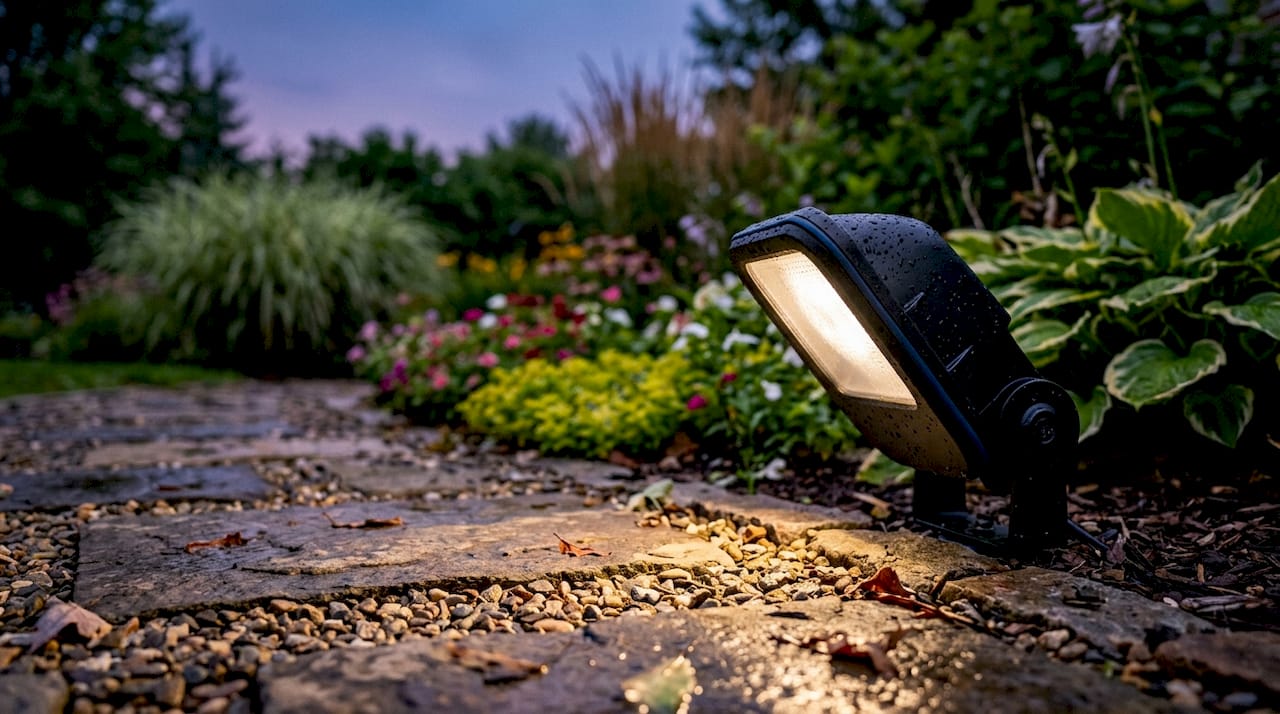
Pathways and steps: Low-level LED path lights improve safety and guide guests without flooding the garden with harsh light.
Garden features: Spotlights highlight trees, sculptures, or water features with focused beams that incandescent bulbs cannot replicate cleanly.
Driveways: Bright, cool-white LEDs on motion sensors provide security and visibility without running continuously.
For more on how LED lighting transforms the feel of an outdoor shading structure, Infinityawnings has covered the topic in detail.
How to select the right LED lighting for your outdoor space
Choosing the right outdoor LED fixtures requires three decisions: the right amount of light, the right colour temperature, and the right fixture type for the location.
Calculate lumens, not watts. Lumens measure actual light output. For a patio or seating area, 300–700 lumens per fixture is typically sufficient. For a driveway or security light, aim for 700–1,300 lumens. Watts only tell you energy consumption, not brightness.
Choose the correct colour temperature. Warm white (2,700–3,000K) suits social and relaxation spaces. Neutral white (3,500–4,000K) works well for pathways and practical areas. Cool white (5,000K+) is best reserved for security or commercial applications.
Select weatherproof fixtures. Any outdoor LED fitting must carry an IP rating. IP44 suits covered areas like porches. IP65 or above is required for exposed positions such as garden walls, driveways, or open pergola structures.
Add controls to maximise savings. Timers, dusk-to-dawn sensors, and motion detectors all reduce unnecessary runtime. The IEA confirms that sensor integration is the next step in maximising outdoor LED efficiency. Smart home compatibility, via systems such as Philips Hue or similar platforms, allows full control from a phone.
Match fixture style to the space. A contemporary garden calls for sleek, low-profile fittings. A traditional cottage garden suits lantern-style LED posts. The fixture is part of the design, not just a functional object.
Pro Tip: Avoid mixing colour temperatures across a single outdoor zone. Warm and cool white lights side by side create a disjointed look. Pick one temperature per area and stay consistent.
For a deeper look at how integrated LED awnings combine shading and lighting in one structure, Infinityawnings explains the options clearly.
How do LED outdoor lights support safety and environmental responsibility?
LED lighting improves outdoor safety in ways that go beyond simple visibility. Traditional bulbs release 80–90% of their energy as heat. LEDs stay cool to the touch. That difference matters around children, pets, and outdoor structures like timber pergolas or fabric awnings, where heat from a traditional bulb creates a genuine fire risk. Reducing heat emission also lessens thermal stress on the fixtures themselves, extending their working life.
From an environmental standpoint, LEDs contain no toxic materials. Traditional fluorescent bulbs contain mercury, which requires specialist disposal. LEDs are fully recyclable and their dramatically lower energy consumption reduces the carbon footprint of your outdoor lighting. For homeowners who are conscious of their environmental impact, switching to LEDs is one of the most straightforward changes available.
Focused, directional light output also reduces light pollution. Poorly designed outdoor lighting scatters light upward and sideways, contributing to sky glow and disrupting local wildlife. LEDs direct light downward and outward to where it is needed, reducing wasted light and its environmental consequences.
Key environmental and safety benefits at a glance:
No mercury or toxic materials, fully recyclable at end of life
Cool-to-touch operation reduces burn and fire risk around children, pets, and structures
Directional output reduces light pollution and sky glow
Lower energy consumption supports household carbon reduction goals
Consistent brightness throughout lifespan keeps security camera footage reliable
For homeowners planning outdoor lighting design across multiple zones, proper placement and fixture selection are as important as the technology itself.
Key takeaways
LED outdoor lighting is the most practical, cost-effective, and environmentally responsible choice for any homeowner looking to improve their exterior spaces.
Point | Details |
Energy savings are substantial | LEDs use at least 75% less energy than incandescent bulbs, cutting outdoor lighting costs significantly. |
Lifespan reduces maintenance | A rated lifespan of 25,000–50,000 hours means far fewer replacements and lower labour costs. |
Cold weather performance is superior | LEDs operate reliably at -20°C, making them the correct choice for UK outdoor conditions year-round. |
Design flexibility is genuine | Colour temperature options and directional output allow precise control over mood, aesthetics, and security. |
Safety and sustainability align | No toxic materials, cool operation, and reduced light pollution make LEDs the responsible outdoor choice. |
Why I think most homeowners underestimate outdoor LED lighting
After years of working with outdoor structures and the lighting that brings them to life, I have noticed a consistent pattern. Homeowners focus on the fixture and forget the light. They choose a fitting because it looks right in a catalogue, then fit whatever bulb comes in the box. The result is outdoor spaces that look flat, feel uninviting, and cost more to run than they should.
The shift to LED is not just a technical upgrade. It changes how you use your outdoor space. A patio with well-placed warm white LEDs under a pergola becomes somewhere you actually want to spend an evening. The same space with a harsh halogen floodlight feels like a car park. That difference in ambience is entirely down to the quality and placement of the light source.
What I find most underappreciated is the maintenance angle. Homeowners accept the inconvenience of replacing outdoor bulbs as a seasonal chore. With LEDs, that chore largely disappears. A fixture installed today should still be performing in ten years. That reliability changes your relationship with the space. You stop thinking about the lighting and start enjoying what it does.
My honest recommendation is to treat outdoor lighting as a design decision, not an afterthought. Choose colour temperature deliberately. Place fixtures to highlight what matters. And choose LEDs not because they are the fashionable option, but because the evidence for their superiority is simply overwhelming.
— Andrew
Pergolas and LED lighting: a natural combination
A pergola is one of the best outdoor structures for showcasing what LED lighting can do. The beams and uprights provide natural mounting points for LED strips, spotlights, and downlighters, creating a layered lighting scheme that works for both relaxed evenings and practical outdoor dining.

Infinityawnings designs and installs pergolas across Yorkshire, Derbyshire, Nottinghamshire, and Lincolnshire, with LED lighting integration available as a built-in feature. The structures are built to last, and pairing them with LED lighting means the whole setup requires minimal maintenance for years. If you are ready to create an outdoor space that works after dark as well as during the day, explore Infinityawnings’ pergola range and see what is possible for your garden.
FAQ
Why are LEDs better than halogen for outdoor use?
LEDs last up to 25 times longer than halogen bulbs and use at least 75% less energy. They also stay cool to the touch, reducing fire risk around outdoor structures and fabrics.
Do LED outdoor lights work in cold weather?
LEDs perform reliably in temperatures as low as -20°C and actually improve in cold conditions. Traditional bulbs often struggle to start in frost, making LEDs the correct choice for UK winters.
What IP rating do I need for outdoor LED fixtures?
IP44 is sufficient for covered areas such as porches. For exposed outdoor positions including garden walls, driveways, and open pergolas, choose IP65 or above for full weatherproofing.
Can LED outdoor lights be used with motion sensors?
LEDs are ideal for motion sensors because they reach full brightness instantly with no warm-up delay. This makes them the most effective choice for security lighting applications.
How much can I save by switching to outdoor LED lighting?
The Department of Energy estimates that switching to LED lighting saves an average household around £225 annually. Outdoor lights that run for several hours each evening contribute significantly to that total.
Recommended
Excellent guide! I liked how you explained that outdoor LED lighting isn't just about aesthetics—it also improves safety, energy efficiency, and the overall usability of outdoor spaces. Features like patios, gardens, and terraces become much more enjoyable when they're well lit. The same attention to detail is valuable for rental properties, especially those accommodating business travellers, where attractive and functional outdoor areas can enhance the guest experience. For landlords looking to attract professionals, corporate letting London services can help maximise the appeal and management of high-quality rental homes. Thanks for sharing such practical advice!