
Why invest in outdoor learning spaces: a practical guide

TL;DR:
Outdoor learning spaces improve pupil engagement, wellbeing, and attainment while extending outdoor seasons and creating revenue opportunities. Evidence links outdoor environments to increased motivation, better behavior, reduced stress, and higher academic success, supporting stronger investment cases. Proper design, safety, and maintenance are essential to ensure these spaces are used year-round and deliver their educational and commercial benefits.
Outdoor learning spaces deliver measurable gains in pupil engagement, wellbeing and attainment — and for homeowners and business owners, they extend usable outdoor seasons while creating flexible amenity or revenue opportunities. The WWF Schools for Nature 2024 report found that nature-rich learning settings increase engagement, reduce stress and can support higher attainment, yet outdoor learning is not integrated for all pupils in most schools. The Natural Connections Demonstration project found 92% of teachers saw improved engagement and 85% reported better behaviour in outdoor lessons. The DfE’s July 2026 early years design guidance now explicitly recommends canopies, flexible doors and covered spaces to enable continuous free-flow play.
Three practical benefits for homeowners and businesses:
Extended usable seasons: a covered, weatherproofed outdoor space works year-round in Yorkshire’s climate, not just on dry summer days.
Flexible revenue and amenity: schools let spaces for community events; hospitality venues add covers; homeowners gain a functional garden room.
Demonstrable education and wellbeing outcomes: credible evidence from WWF, Natural Connections and DfE makes the investment case straightforward for governors, trustees and planning committees.
Table of Contents
What does the evidence say about outdoor learning benefits?
The case for investing in outdoor education is not anecdotal. Systematic reviews show positive effects across social and academic outcomes, with longer programmes producing stronger results than single sessions. A forecast social return on investment of £4.32 for every £1 invested has been calculated for schools that embed outdoor learning as a whole-school approach.
Evidence bullets for proposals:
Engagement and behaviour: Natural Connections found 92% of teachers reported improved engagement; 85% saw better behaviour outdoors.
Attainment: WWF’s 2024 report links nature-rich settings to reduced stress and higher attainment potential.
Wellbeing: contact with nature is positively associated with resilience, lower stress and improved mental health in children and teenagers.
Staff benefits: teachers and support staff consistently report that outdoor learning is a positive experience for them as well as pupils.
Commercial value: for hospitality and residential properties, a covered outdoor space directly increases usable floor area and customer capacity.
How outdoor learning maps to UK inspection and design guidance
UCL Institute of Education recommends explicitly aligning outdoor learning outcomes — teamwork, resilience, communication — with Ofsted criteria for personal development and SMSC (spiritual, moral, social and cultural development). That alignment turns a shading project from a facilities upgrade into a curriculum investment, which is a much easier argument to win with governors.
The DfE’s July 2026 early years design guidance formalises what good practitioners have known for years: indoor and outdoor environments should connect so children move freely between them. Covered spaces and canopies are specifically cited as enabling that free-flow design.
Checklist: linking outdoor features to inspection priorities
Canopy or pergola over play area → supports free-flow access (DfE early years guidance; EYFS)
Covered gathering space → enables SMSC and personal development activities (Ofsted)
All-weather surface with drainage → removes weather as a barrier to outdoor curriculum delivery
Accessible routes and level thresholds → supports inclusive provision (Ofsted quality of education)
Integrated lighting → extends usable hours for after-school clubs and lettings
Key design and safety considerations for UK outdoor spaces
Orientation matters more than most buyers expect. A south-facing canopy maximises winter sun while a retractable system lets you manage summer glare. Prevailing westerly winds across Yorkshire mean wind-load ratings are non-negotiable, and drainage must be planned from day one — a pooling surface becomes unusable within weeks. See Infinityawnings’s guide to weather protection for playgrounds for a practical breakdown of surface and shelter options.
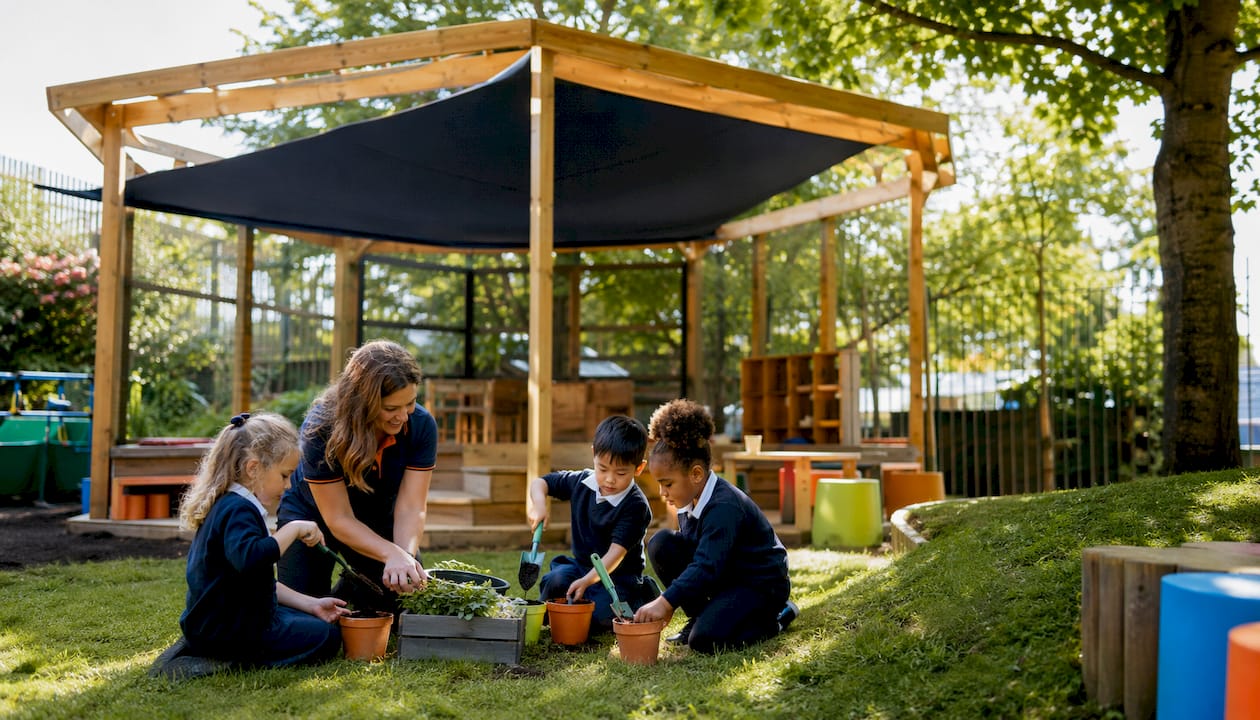
Accessibility is not optional. Non-slip surfaces, level thresholds, clear sightlines for supervision and adequate turning space for wheelchairs should be specified before a structure is ordered, not retrofitted. Sensory considerations — shade from direct sun, shelter from wind noise — also matter for pupils with additional needs.
Safety checklist to confirm with your supplier:
Wind-load rating appropriate for the site’s exposure category
Non-slip, all-weather surface beneath and around the structure
Clear sightlines from staff positions to all pupil areas
Electrical installation to Part P by a qualified contractor (for lighting and heaters)
Structural calculations available for planning or building control if required
Pro Tip: Many correctly specified shading structures — pergolas, retractable awnings — avoid full planning applications when sited and specified correctly. Check your local authority’s permitted development rules early; it can save weeks.
Which shading and shelter features matter most?
Fabric quality determines longevity. Look for solution-dyed acrylic with a UV protection rating and a water-repellent finish; cheap polyester fades and sags within two seasons in Yorkshire’s weather. Frame corrosion resistance — powder-coated aluminium as a minimum — is equally critical for year-round installations.
Fixed vs retractable: fixed structures give maximum weather protection and suit permanent outdoor classrooms. Retractable systems offer flexibility — open on warm days, closed when it rains — and tend to suit hospitality and residential settings where the space serves multiple purposes. Electric drives add convenience and are worth the cost for commercial or school use where manual operation becomes impractical. Explore the playground shading options available for 2026 for a fuller comparison.
Comfort add-ons that extend year-round use:
Infra-red heaters: keep the space usable from September through April
LED lighting: enables after-school and evening use without additional electrical runs
Side screens: block wind and rain ingress; removable versions suit seasonal use
Automated weather sensors: retract the system before wind speeds become damaging
Infinityawnings supplies and installs products from Weinor, Llaza, Selt, Tarasola and Morvelle. Each brand carries its own warranty terms and specialist strengths — Weinor for retractable precision engineering, Tarasola and Morvelle for premium pergola systems, Llaza and Selt for robust commercial-grade structures. Specifying a named brand matters because it determines parts availability, warranty support and the installer’s ability to service the system five years from now.
How Infinityawnings approaches outdoor learning projects
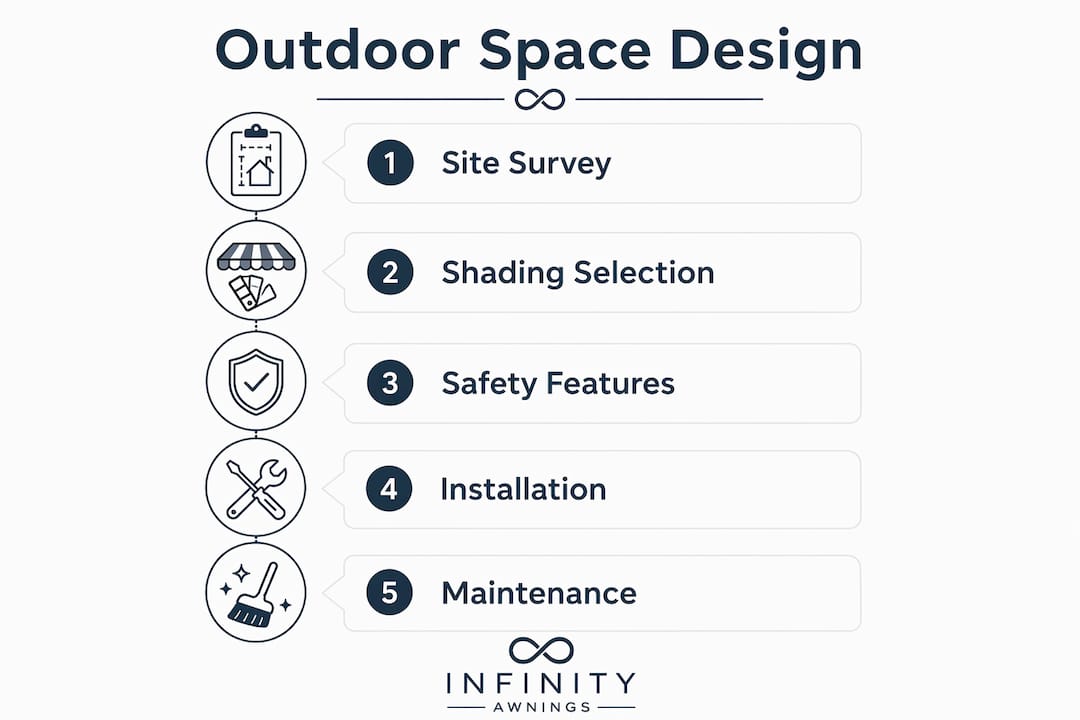
A typical project runs: initial enquiry → site survey → design proposal and product selection → planning checks → fabrication → installation → commissioning and handover. For schools and nurseries, Infinityawnings typically specifies pergola-style systems or retractable awnings with integrated lighting and heaters, side screens for wind protection, and a maintenance plan to protect the asset. The outdoor classroom setup process guide covers each stage in detail.
What to expect at each stage:
Site survey: orientation, wind exposure, drainage, access and structural fixing points assessed
Design proposal: product selection, fabric and frame options, add-ons and layout
Planning checks: confirm permitted development status or submit prior approval if needed
Fabrication: bespoke manufacture to site dimensions
Installation and commissioning: structure erected, electrics connected, controls tested, staff shown operation
Warranties vary by brand and product, but most premium systems carry a minimum five-year structural warranty. Maintenance contracts — annual inspection, fabric cleaning, drive servicing — protect that warranty and keep the space in active use rather than becoming a storage area.
Budgeting, cost drivers and funding routes
Cost is driven by size, bespoke design complexity, automation, add-ons (lighting, heaters, side screens), groundworks and any electrical or planning work. A simple manual retractable awning sits at the lower end; a fully automated pergola with heating, lighting and side screens sits considerably higher. Specifying clearly upfront avoids scope creep.
Funding routes for schools and nurseries:
Map outdoor learning outcomes to DfE/Ofsted priorities and include the investment in the school development plan budget
Apply to local authority or multi-academy trust capital funds, citing WWF and Natural Connections evidence
Community fundraising and parent-teacher association campaigns for smaller elements
Small grants from environmental and education charities (check the LOtC network for current opportunities)
Budgeting checklist for a funding application:
Anticipated structure lifespan (typically 15–25 years for premium systems)
Annual maintenance cost estimate
Projected usage hours per week and per year
Learning outcomes to be evaluated (engagement, behaviour, lesson frequency)
Lettings or commercial income projections where applicable
What does a realistic project timeline look like?
Stage | Typical duration |
Initial enquiry and site survey | 1–2 weeks |
Design proposal and specification | 1–2 weeks |
Planning checks (if required) | 4 weeks |
Fabrication | 4 weeks |
Installation | 1–5 days depending on scale |
Commissioning and handover | 1 day |
Spring and early summer are the busiest installation periods; booking a survey in autumn or winter often secures earlier fabrication slots and avoids the end-of-academic-year rush. Autumn installs are perfectly feasible — commissioning in cooler weather simply means testing heating and lighting from day one.
Maintenance checklist:
Annual fabric inspection and clean (specialist cleaner, not domestic detergent)
Electric drive servicing every 12–18 months
Frame and fixings check after any severe weather event
Warranty registration completed at handover
Maintenance contract reviewed at year three
Short use cases: how different organisations use outdoor learning spaces
Primary school, covered play pavilion: a Yorkshire primary installed a pergola-style canopy over a paved area adjacent to the classroom. Free-flow access via wide folding doors increased outdoor lesson frequency from one session per fortnight to three per week. Wheelchair-accessible paths and non-slip surfaces were specified from the outset.
Nursery, pergola with sensory planting: a nursery integrated a retractable awning over a raised planting bed area, providing shade for sensory play in summer and shelter for mud-kitchen activities in autumn. The covered zone became the most-used outdoor area within a term.
Café and restaurant, heated pergola: a hospitality client extended trading by adding a fully enclosed pergola with infra-red heaters and side screens, increasing outdoor covers year-round and generating additional revenue from October through March.
How to make the investment case to governors or owners
A strong proposal has five components: a one-line claim, evidence, a cost summary, expected outcomes, and an evaluation plan.
Proposal checklist:
Executive summary: one sentence stating the investment and the primary outcome (e.g. “A covered outdoor learning space will enable daily outdoor curriculum delivery and align with DfE free-flow guidance”)
Evidence bullets: cite WWF 2024, Natural Connections (92% engagement improvement, 85% behaviour improvement), DfE July 2026 guidance and UCL IoE alignment recommendations
Cost summary: total project cost, funding sources identified, annual maintenance estimate
Expected outcomes: usage hours, lesson frequency, behaviour incident data, lettings income
Evaluation plan: baseline data collected before installation; review at 6 and 12 months
Numbered steps for presenting to governors:
Circulate the one-page proposal summary one week before the meeting.
Open with the evidence: Natural Connections and WWF figures land quickly with non-specialist audiences.
Present the cost against the forecast SROI of £4.32 per £1 invested (LOtC evidence).
Show the Ofsted/DfE alignment checklist — governors respond to inspection-readiness arguments.
Close with the supplier letter of intent, site plan and maintenance schedule as attachments.
Suggested attachments: site photographs, scaled site plan, supplier letter of intent, product specification sheet, maintenance schedule and warranty summary.
Key takeaways
Outdoor learning spaces backed by quality shading deliver measurable educational outcomes, extend usable seasons year-round, and generate a forecast social return on investment when embedded as a whole-school approach.
Point | Details |
Evidence is strong | Natural Connections found 92% of teachers saw improved engagement; WWF 2024 links nature-rich settings to reduced stress and higher attainment. |
Policy alignment matters | Mapping outdoor features to DfE July 2026 guidance and Ofsted SMSC criteria strengthens funding bids significantly. |
Design drives ROI | Wind rating, drainage, accessibility and comfort add-ons (heaters, lighting) determine whether a space is used daily or left empty. |
Budget realistically | Cost drivers include size, automation, add-ons and groundworks; a maintenance contract protects the asset and the warranty. |
Infinityawnings | Infinityawnings supplies and installs Weinor, Llaza, Selt, Tarasola and Morvelle systems across Yorkshire, with free surveys and maintenance packages. |
A note on what actually makes these projects work
The evidence on outdoor learning is genuinely compelling — but the structures that sit unused tell a different story. Every practitioner network, from LOtC to Natural England’s Children and Nature Programme, points to the same conclusion: a covered space alone does not change anything. What changes outcomes is staff confidence, a whole-school commitment to using the space regularly, and a structure specified for year-round use rather than fair-weather days.
That means heating and lighting are not luxuries. A pergola that is too cold to use from October to April has effectively halved its own return on investment. The same applies to maintenance: a drive mechanism that seizes after two winters, or a fabric that sags and pools water, removes the space from active use just as effectively as bad weather.
The procurement decisions that matter most are not the visible ones — frame colour, fabric pattern — but the ones that determine whether the space works on a wet Tuesday in November. Wind rating, drainage, drive quality, and a maintenance contract: get those right and the educational and commercial case looks after itself.
Infinityawnings: free survey and installation across Yorkshire
If you are ready to move from evidence to specification, Infinityawnings offers a free site survey across Yorkshire, Derbyshire, Nottinghamshire and Lincolnshire. With over 15 years of experience supplying and installing premium outdoor shading for schools, nurseries, hospitality venues and residential properties, the team specifies structures that work year-round, not just in summer.
Supply partners include Weinor, Llaza, Selt, Tarasola and Morvelle — each chosen for durability, warranty support and parts availability. Every installation includes commissioning, handover and the option of an ongoing maintenance contract to protect your investment. For schools and nurseries, Infinityawnings can provide a supplier letter of intent to support funding applications.
Browse the pergolas range or get in touch to request your free survey and bespoke specification.
Useful sources and further reading
WWF Schools for Nature Report 2024: primary evidence on engagement, stress reduction and attainment gains from nature-rich learning; cite directly in funding bids.
Natural Connections Demonstration Project (GOV.UK): England’s largest outdoor learning study; the 92% engagement and 85% behaviour improvement figures are the most-cited statistics in the sector.
DfE Early Years Design Guidance, July 2026: official design recommendations for canopies, flexible doors and free-flow spaces; use to validate specification choices with governors and planners.
UCL Institute of Education / Outdoor Learning Research: guidance on mapping outdoor outcomes to Ofsted criteria; useful for structuring funding proposals.
LOtC Evidence Summary, November 2022: includes the £4.32 SROI forecast and whole-school implementation guidance.
Institute for Outdoor Learning: guide on benefits: practical recommendations on covered spaces, tactile surfaces and sensory features for early years and primary settings.
Recommended
Comments