
Pergola roof types explained: choose the perfect shade

TL;DR:
The choice of pergola roof greatly impacts its weatherproofing, usability, and durability in the British climate.
Louvred and retractable roofs offer flexible protection and can extend outdoor use across all seasons.
Proper planning and selecting adaptable, high-quality roofing systems ensure a functional, visually appealing outdoor space.
Most homeowners assume that a pergola is just a pergola, that the roof on top is a minor afterthought once the posts and beams are sorted. That assumption leads to leaky patios in October, stifling glass boxes in July, and expensive structures that gather cobwebs because they simply do not work with the British weather. Across Yorkshire, Derbyshire, Nottinghamshire, and Lincolnshire, we see it regularly. The framework looks wonderful. The roof lets everything down. This article walks you through every major pergola roof type, explains how each performs in our region’s unpredictable climate, and helps you match the right solution to your property, your lifestyle, and your budget.
Table of Contents
Key Takeaways
Point | Details |
Roof choice impacts function | Getting the right pergola roof type means year-round outdoor use and lasting value. |
Match roof to local weather | British weather calls for durable, flexible roofs that handle rain, wind, and sunshine. |
Style and maintenance both matter | Blending design with practicality ensures your pergola is both beautiful and easy to use. |
Expert advice makes a difference | Local specialists help you avoid mistakes and choose the perfect solution for your space. |
What is a pergola and why does the roof matter?
Let us start with a quick definition, because the word “pergola” gets applied to all sorts of structures in garden centres and catalogues, not all of them accurate. A traditional pergola is an outdoor framework of vertical posts supporting horizontal cross beams, typically creating a defined, open-sided space for relaxing, dining, or entertaining. What sits on top of those beams determines almost everything about how useful the structure actually is.
A pergola without any overhead covering is essentially decorative. It looks attractive, provides a little dappled shade from climbing plants, and that is about it. The moment you add a roof material, the pergola becomes a genuine outdoor room. The type of roof you choose controls how much light enters, whether rain stops play, how warm or cool the space feels, and ultimately how many days per year the area is actually usable.
Pergola benefits are broad and well documented. As one overview puts it, pergolas provide flexible outdoor living spaces ideal for both homes and businesses, from residential garden retreats to commercial hospitality settings where outdoor seating directly affects revenue.
For properties in our corner of England, roof choice carries extra weight. British weather does not follow a predictable script. A warm Sunday in May can turn into horizontal rain by afternoon. August delivers heatwaves and sudden thunderstorms in the same week. Any roof that only performs well in one season will leave you frustrated for the other three. Here are the core factors worth weighing before you choose:
Durability: Can the material withstand sustained wind and rain without warping, cracking, or leaking?
Maintenance: How often does it need cleaning, sealing, or replacing, and how easy is that access?
Visual style: Does it complement your home’s architecture and garden planting?
Climate suitability: Will it cope with Yorkshire frost, Lincolnshire coastal wind, or Derbyshire rainfall?
Year-round usability: Does it extend your season or does it only work in summer?
The roof is not just the finish on top of your pergola. It is the single biggest decision you will make about how the space performs. Get it right and you gain a room. Get it wrong and you gain an expensive garden ornament.
Key pergola roof types explained
Now that you know why the roof matters, let us unpack your main options with a clear comparison. There are six principal types you will encounter when shopping for a pergola in the UK, and each suits a different set of priorities.
Fixed solid roofs (timber, steel, or composite panels) are permanent, structural, and substantial. They provide full weatherproofing and can be insulated. The downside is inflexibility: once fitted, you cannot adjust light or ventilation without an additional opening like a skylight or ventilation louvre.
Retractable fabric roofs use motorised or manual mechanisms to pull a high-performance fabric canopy across the pergola frame. Retractable roofs give flexible shading and rain protection ideal for British weather, letting you open the space on sunny days and close it quickly when a shower arrives.
Louvred roofs are arguably the most sophisticated option currently available. Aluminium louvre blades sit across the roof frame and rotate on a central axis, controlled manually or via a motor. Smart shade options like these allow you to control ventilation and sunlight, adapting outdoor space instantly, which is extraordinarily useful when conditions change rapidly.
Polycarbonate panels are translucent, lightweight, and relatively affordable. They let daylight through while keeping rain out, making them a popular choice for those on tighter budgets. The trade-off is that they can look a little industrial, and some grades yellow over time under UV exposure.
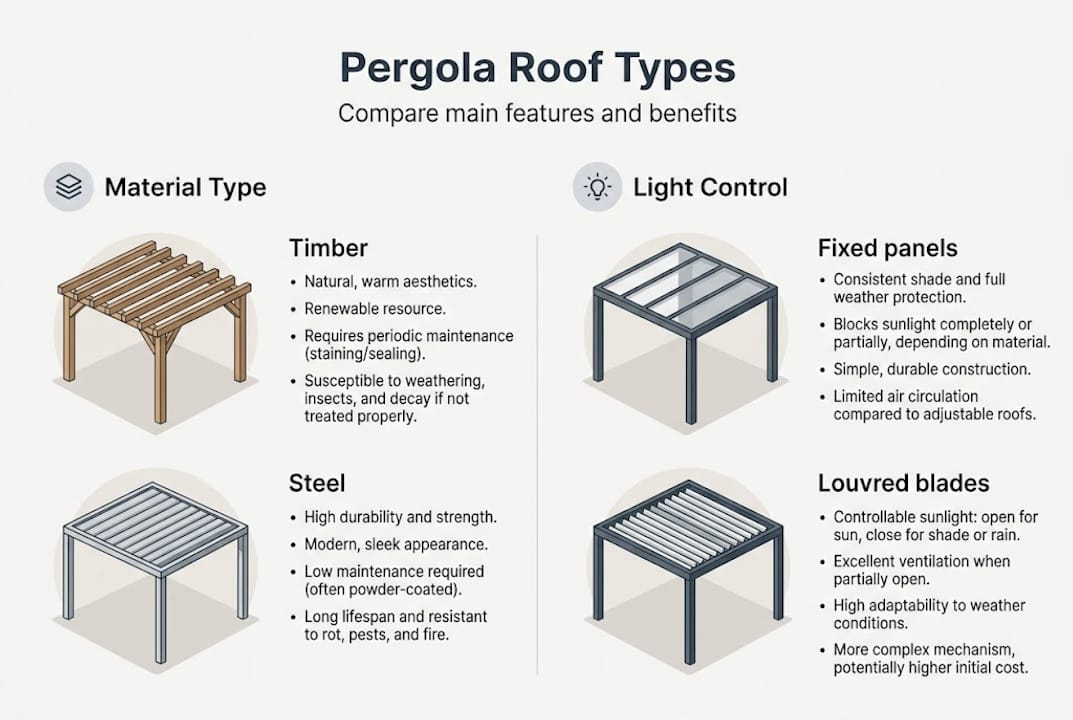
Glass roofs look stunning and flood the space with natural light, but they come with real practical considerations. They are heavy, expensive to install, and can create a greenhouse effect in direct summer sun unless paired with a UV coating or integrated blinds.
Fabric canopies without mechanical retraction (fixed fabric sails or stretched canopies) offer a softer, more informal aesthetic at lower cost but provide minimal rain protection and deteriorate faster in harsh weather.
Here is a straightforward comparison to help you weigh the options at a glance:
Roof type | Rain protection | Light control | Maintenance | Approximate lifespan |
Fixed solid | Excellent | Fixed | Low | 25+ years |
Retractable fabric | Good (when closed) | High | Medium | 10 to 15 years |
Louvred aluminium | Excellent | Excellent | Low | 20+ years |
Polycarbonate | Good | Medium | Low | 10 to 20 years |
Glass | Excellent | Medium | Medium | 20+ years |
Fixed fabric sail | Poor | Medium | High | 5 to 8 years |
Pro Tip: If you are installing a pergola for a commercial setting such as a pub garden or restaurant terrace, prioritise louvred or retractable options. Operators need to adjust conditions quickly as customer comfort changes, and a fixed roof gives you no flexibility to do that.
How roof choice affects year-round use
Knowing your options, it is equally important to see how different roofs perform across Britain’s changeable weather. The idea that a pergola is a summer-only structure is one we actively challenge. With the right roof, your outdoor space can be genuinely useful from February through to November, and in milder years, across all twelve months.
All-weather pergolas can extend outdoor living for all seasons with the right roof materials, particularly when combined with integrated heating and side screening. The roof material is what makes or breaks that ambition.
Here is how the main roof types stack up against real British weather conditions:
Weather condition | Best performer | Weakest performer |
Heavy rain | Louvred (closed) or glass | Fixed fabric sail |
Strong wind | Fixed solid or aluminium louvre | Retractable fabric (open) |
Summer heat | Louvred (open for ventilation) | Glass (unventilated) |
Winter frost | Fixed solid | Polycarbonate (brittle grades) |
UV exposure | Treated glass or fabric with UV coating | Basic polycarbonate |
When planning for year-round use, it helps to think in practical steps rather than abstract concepts:
Assess your primary season. Identify when you most want to use the space and which weather conditions are most likely to disrupt that. In Yorkshire, summer rain and autumn wind are the two biggest culprits.
Consider heat retention. A roof that holds warmth in March and October makes those shoulder seasons genuinely comfortable, especially when combined with overhead heaters. Flat roof benefits highlight how low-pitch covered structures retain warmth more effectively than open alternatives.
Plan for drainage. Every closed roof needs a clear drainage path. Louvred roofs channel water through integrated gutters in the frame. Glass and polycarbonate need properly pitched runs to a downpipe. Fabric roofs need tension and pitch to avoid pooling.
Think about wind loading. Properties in exposed areas of Lincolnshire or elevated parts of Derbyshire need roof systems with tested wind resistance ratings. Retractable fabric should always be retracted in high winds to prevent damage.
Check the UK shading solutions available to you. Some roof types combine well with side panels or screens to create a fully weatherproof enclosure during winter months.
Pro Tip: Ask any supplier for the wind and rain resistance certification for their product, not just a general description. Reputable manufacturers provide tested Beaufort scale ratings and water resistance classifications. This is the difference between a product that is described as weatherproof and one that has actually been proved to be so.
Design, style and practical considerations
With performance in mind, do not overlook aesthetics and day-to-day usability. The most technically impressive roof in the world will still feel like a mistake if it clashes with your home’s architecture or becomes a nightmare to keep clean.
One of the most common mistakes we see is homeowners choosing a roof style based purely on photographs online, without considering how the material, weight, or colour will look against the actual brickwork, render, or cladding of their specific house. A sleek anthracite aluminium louvre system looks exceptional against a contemporary extension. Against a traditional stone Derbyshire farmhouse, it can feel jarringly out of place.
The right pergola design should complement your garden and lifestyle for the best results, and that means thinking beyond the roof in isolation. Consider:
Colour matching: Most aluminium systems come in RAL powder-coat colours. Choose something that echoes window frames, guttering, or garden furniture rather than treating the pergola as a standalone object.
Transparency and light: A glass or polycarbonate roof lets in more light than a fabric or louvred system in a closed position. If your pergola is attached to a house wall and adjacent to a kitchen window, a glass roof might actually reduce natural light inside the home.
Access and cleaning: Fabric roofs need periodic cleaning to prevent mould in damp British conditions. Glass requires regular washing to stay presentable. Louvred aluminium is the lowest-effort option in this regard, typically needing only an occasional rinse.
Privacy: A solid or opaque roof offers visual screening from upstairs windows in neighbouring properties, which matters in denser urban or suburban settings. A glass or polycarbonate roof does not.
Integration with extras: The best pergola installations are planned with LED lighting, overhead heaters, and side screens in mind from the start. Adding these after the fact is possible but often more complicated and more expensive.
Thinking through patio shading steps before committing to any single product is genuinely worthwhile. Equally, reviewing choosing shading tips from experienced installers can prevent the most avoidable errors, particularly around structural fixings, planning requirements, and drainage routing.
A useful checklist before finalising your roof type:
Does it match your home’s architectural style?
Can you access it safely for cleaning and maintenance?
Does your garden get more morning or afternoon sun, and does the roof type account for that?
Have you confirmed planning requirements with your local authority?
Is the supplier able to provide a structural warranty alongside the product warranty?
Bold fact worth noting: Industry surveys consistently show that well-designed outdoor living spaces add between five and fifteen per cent to the perceived value of a residential property, with covered and weatherproofed structures outperforming open or seasonal ones in that figure.
A fresh perspective on selecting a pergola roof for UK homes
Here is something we observe repeatedly after more than fifteen years in this industry: the customers who end up most satisfied with their pergola roofs are almost never the ones who started with the cheapest option or the most visually striking photograph. They are the ones who started with a ruthless question: “How many days a year do I actually want to use this space, and what would stop me?”
The instinct to lead with style or lead with budget is understandable. But in a climate like ours, both approaches tend to produce the same outcome: a structure that works brilliantly for six weeks in summer and sits unused for the other ten months. That is a significant investment for a modest return.
The smarter approach is to start with adaptability. A louvred roof costs more than polycarbonate. But when you account for the extended season, the reduced maintenance, and the fact that you are not replacing it in ten years, the cost per usable day is dramatically lower. We often recommend that customers review their outdoor shading perspective before committing to any single product type, because the right solution is rarely the most obvious one. Invest in flexibility, and the British climate becomes far less of an obstacle than it first appears.
Find your perfect pergola roof with Infinity Awnings
Ready to take the next step? Here is how Infinity Awnings can help you turn inspiration into reality.
At Infinity Awnings, we have spent over fifteen years helping homeowners and businesses across Yorkshire, Derbyshire, Nottinghamshire, and Lincolnshire choose pergola roofs that genuinely suit their property and their climate. We stock premium systems from leading brands including Weinor, Tarasola, and Llaza, covering everything from motorised louvred roofs to high-performance retractable canopies. Whether you are planning a residential garden room or a commercial hospitality terrace, our team can guide you through the options, arrange a site visit, and provide a no-obligation quote. Browse pergola roofs on our website to explore the full range, or get in touch to book a free consultation with one of our experienced outdoor living specialists.
Frequently asked questions
Which pergola roof type is best for rainy UK weather?
Retractable roofs allow you to quickly adapt to rain, and louvred systems channel water away efficiently through integrated gutters, making both strong choices for wet British conditions.
Do glass pergola roofs get too hot in summer?
Glass roofs can trap heat if unventilated, and some roof materials retain more heat than others, so look for glass options with UV coatings or pair them with integrated blinds for summer comfort.
Are there low-maintenance pergola roof options?
Aluminium louvred roofs and quality polycarbonate panels typically demand the least upkeep, though roof material affects long-term maintenance needs significantly depending on your local weather exposure.
Can I add a pergola roof to an existing structure?
Many roof systems can be retrofitted onto an existing pergola frame, but professional assessment is essential to check load-bearing capacity, drainage routing, and weatherproofing before installation begins.
Recommended
Comments